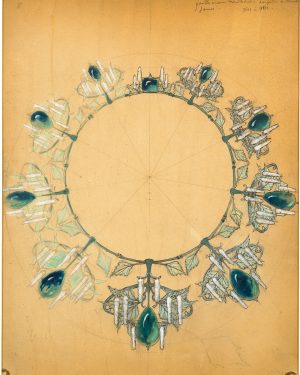
RENE LALIQUE – “COLLIER, FEUILLES ET PAMPILLES”
“COLLIER, FEUILLES ET PAMPILLES”
Chinese ink, gouache and watercolor
28 x 22 cm.

Art Nouveau & Art Déco - Gallery in Monaco
Showing 73–96 of 937 results
“COLLIER, FEUILLES ET PAMPILLES”
Chinese ink, gouache and watercolor
28 x 22 cm.
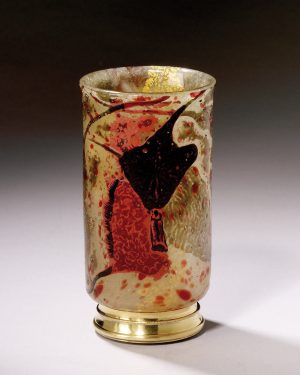
VASE, CIRCA 1900
Engraved marquetry with a design of ray and aquatic flora
Powder inclusions and inclusion of shattered gold foils, hammered with small facets
Silver gilt mount with French Minerva mark
Vertically engraved signature
17 cm. high
No similar example known to exist
Bibliography
For the same shape of the mounted vase: Tsuneo Yoshimizu, The Glass Arts of Emile Gallé, Gakken 1985, n.144; without the mount n. 143 and 184
Georges de Bartha, Glass by Gallé, Thames & Hudson Ltd, 1984, p. 59, n. 61 (EU 1900)
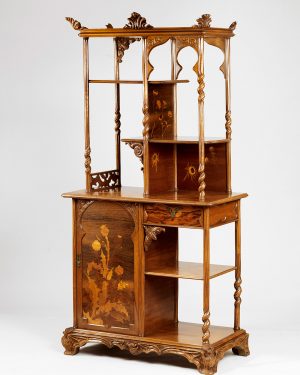
VITRINE, CIRCA 1900
Decorated with marquetry panels and sculptures
of snails, bats, peacock moth and acanthus leaves,
the base entirely sculpted with bats
Signed
191 x 93 x 50 cm.
Another example
The Yamazaki Mazak Museum of Art, Japon, inv. n° ANF-360901
Bibliography
The Yamazaki Mazak Museum of Art, Glass, Ceramic and Furniture, Japon, 2010, ill. p. 114 & 115
Georges de Bartha & al, Gallé furniture, Antique collectors club, 2012, ill. p. 299
CUP, CIRCA 1904
Translucent polychrome enamel on soft white porcelain highlighted with gold.
Signed and dated C. Naudot 1904 and C.N. in gold
Height: 8 cm.
Bibliography
The porcelains by Naudot are illustrated in:
– Art et Décoration, 1901, volum II, page 52
– Der Moderne Stil, Julius Hoffmann jr., A. Guérinet, Paris, Librairie d’Art Décoratif, n.d.,
volum 4, pl. 44
Paul Arthur, French Art Nouveau Ceramics, An Illustrated Dictionary, Norma éditions, 2015, ill. p. 289
FOOTED CUP, 1897-1910
Translucent polychrome enamel on soft white porcelain highlighted with gold
Signed C. Naudot and C.N. in gold.
Height: 4.5 cm.
Bibliography
“M. Naudot est le seul fabricant de porcelaine de pâte tendre, dite porcelaine française.
Il expose nombre de pièces remarquables par la qualité de la matière et l’éclat des émaux
qui les recouvrent. De plus, il a découpé dans la pâte crue des fleurs d’une finesse extrême,
qui, remplies ensuite d’émail, forment sur la pièce comme une fine dentelle lumineuse”.
Alexandre Sandier, La Céramique à l’Exposition Universelle de 1900, Art et Décoration, December 1900, p. 194
Camille Naudot is credited with having mastered the technique of filling the blanks
of his openwork soft paste porcelain with colored translucent enamels without having
to trap them with metal or gold thin wire
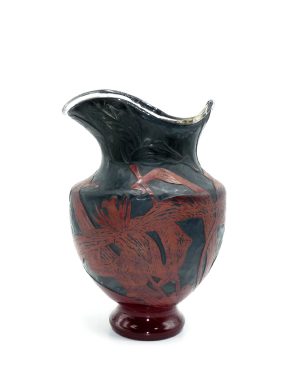
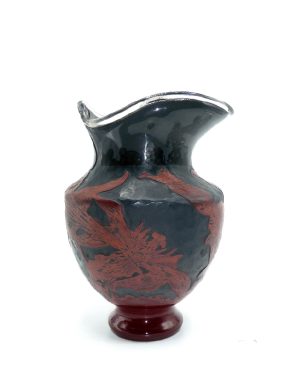
AIGUIERE AUX IRIS, 1893
Multilayered glass, partly hammered with small irregular facets and wheel-carved decor of iris flowers
Height: 22 cm.
Most likely blown and engraved in Meisenthal then wheel-carved in Nancy
Designed to be mounted in silver, an example was acquired directly from Emile Gallé in 1893 by the Union Centrale des Arts Décoratifs, the current Musée des Arts décoratifs, inventory number 7775. The mount is by Joseph Joindy, chased by Francis Peureux who was the main silver chaser at the Maison Boucheron. Our example is the unmounted one that remained in Emile Gallé’s family and no other example known to exist.
In his book L’Oeuvre de verre d’Emile Gallé, copyright 1998 Editions Messene, Paris,
François Le Tacon illustrates a ewer in red and black multilayred glass, that he dates 1893 and which is located in the castle museum of Boulogne-sur-Mer, inventory n. 750, height: 25 cm.; We read: “A l’opposé, une cruche de 1893 (fig.62), sans caractère symbolique, est un objet intrinsèquement décoratif. Soufflée et gravée à Meisenthal à l’acide, puis reprise à la roue à Nancy, elle était destinée à être montée à Paris sur argent doré, comme l’exemplaire du musée des Arts décoratifs. Elle est en cristal triple couche : une interne translucide, une intermédiaire noire foncée et une externe rouge. L’opposition violente entre le noir et le rouge donne à cette pièce un aspect particulier, encore souligné par l’agressivité de la gravure qui s’apparente beaucoup à une taille. La monture en argent ciselé et doré, de style rocaille, avec deux serpents s’enroulant autour de l’anse, plutôt de style Art nouveau, accentue encore les oppositions. La pièce parisienne, à décor d’iris, a été achetée directement à Gallé par le musée; celle de Boulogne, à décor de lys, appartenait à Charles Lebeau”.
“FUSCHIA” COUPE, CIRCA 1908
Pâte d’émail mauve, green and orange brown on a caramel background. Design in shallow relief.
Signed with the circular seal and numbered BK 2. Has its original box.
Height: 5.7 cm.
Diameter: 11.7 cm.
Bibliography
Véronique Ayrolles, François Décorchemont Maître de la pâte de verre, Editions Norma, Paris 2006, ill. p. 40, p. 227
Exhibition
Musée du Verre François Décorchemont, Conches-en-Ouches, François Décorchemont – L’alchimie de la matière, de la couleur et de la lumière, 24 May 2025 – 30 November 2025
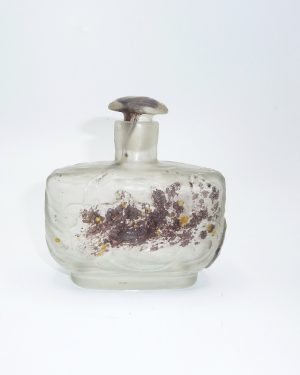
BOTTLE AND STOPPER
Bottle and stopper, of flattened shape, in thick frosted glass with powder and gold foil inclusions,
overlaid and entirely chased with a bat on each side on a background featuring a moon crescent and waves.
Original stopper with hammered top and foil inclusions.
Incised signature on the side.
10.5 x 11 x 4.5 cm.
Bibliography
Le Modern Style, page 129
Provenance
Formerly in the collection of Maria de Beyrie, Paris
Private collection, Paris
Acquired from the above
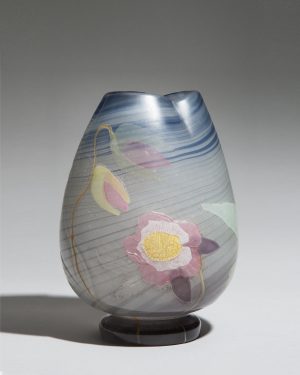
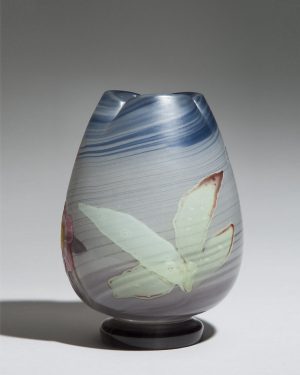
VASE, CIRCA 1900
Footed egg shaped glass marquetry vase with a pinched neck and a design of finely carved water lilies
Similar example at the Kitazawa Art Museum, Suwa, Japon
Height: 19.5 cm.
Exhibition
Emile Gallé – Nature and Symbol / Le Langage des Fleurs et des Choses Muettes,
16 January – 10 April 2016, Tokyo Metropolitan Teien Art Museum; 24 April – 5 June 2016, Utsunom
Bibliography
Alastair Duncan, The Paris Salons Volume IV: Ceramics & Glass, ill. on the cover page and p. 40.
“HOMMAGE A CAMILLE CAVALLIER” LAMP, 1924
Blown and engraved glass
Inscribed: Charlon/Pont à Mousson/Camille Cavallier/Hommage/des Conseillers/du Commerce Extérieur/de la Région de l’Est/1924″ et “Métallurgie/Pont à Mousson/1856/Foug/1905 Au Boue/1905/S’Estienne du Rouvray/1915
Height: 74 cm.
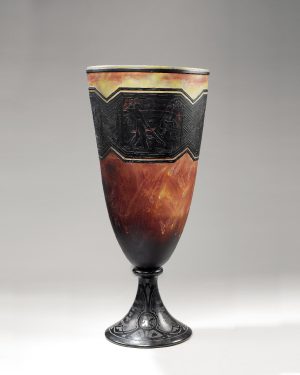
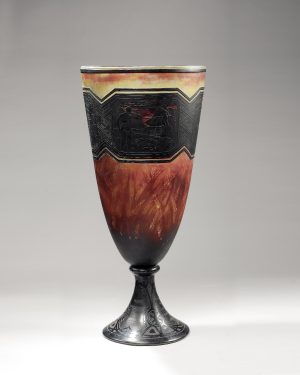
“Ce magnifique vase est la réplique de celui qui a été offert officiellement à Camille Cavallier, président-fondateur des Fonderies de Pont-à-Mousson, en 1924. Sur un fond symbolique de blés mûrs au temps de la moisson, quatre médaillons reproduisent dans une dominante rougeoyante qui leur convient, des scènes d’atelier, depuis la mine jusqu’à la forge. Tous ces motifs sculptés finement dans le verre, sont les témoins de la qualité exceptionnelle des graveurs sur verre de cette époque. Leur travail n’était pas exempt d’aléas, et si ce vase n’est qu’une réplique de l’original, quoique terminé, c’est qu’il est légèrement fêlé. Au cours des derniers coups de roue, une crique s’est déclarée inopinèment, rendant nécessaire la reprise à zéro du travail sur une autre pièce en attente, qui ne dut qu’à un tour de force d’être prête à temps. Le principal auteur du travail était le célèbre H. Racadot”. (Notice of Noël Daum in the catalogue of the exhibition at the Musée des Beaux-Arts de Nancy)
Exhibition
DAUM Cent ans de verrerie d’art “trois styles”, 3ème exposition, March 1979 – March 1980, musée des Beaux-Arts de Nancy, n. 16 in the exhibition catalogue
Bibliography
Noël Daum, Daum Maîtres Verriers, Edita Denoël, 1980, ill. p. 108
Clothilde Bacri, Daum, Paris, 1992, ill. p. 152
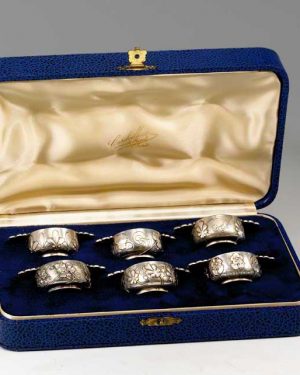
SIX SALT CELLARS, CIRCA 1900
Silver, each with a different design of leaves, including mistletoe, clover, columbine and holly
Signed
Modern fitted box
With silversmith marks
Height: 2.1 cm.
Width: 6.8 cm.
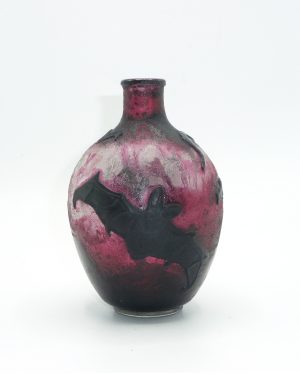
BALUSTER VASE, CIRCA 1900
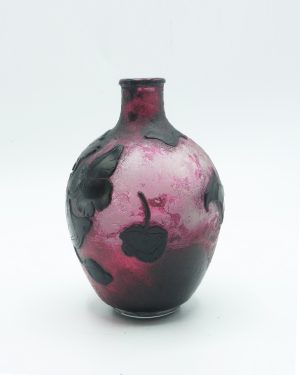
Baluster vase with small upright neck.
Clear glass overlaid in oxblood acid etched and entirely wheel carved featuring a large and
two small bats on a frosted background.
Wheel cut signature heightened in gold with the Cross of Lorraine on a hammered background.
Height: 15 cm.
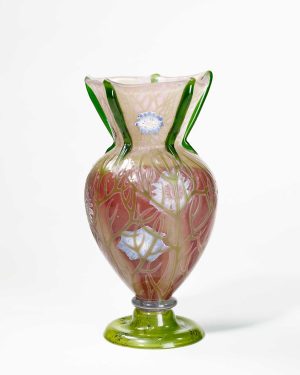
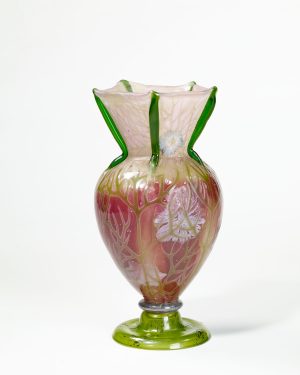
“LA NIGELLE DES PRES”, AN IMPORTANT FOOTED VASE, CIRCA 1900
Marquetry and finely wheel-carved glass, the pink surface overlaid with white
and blue flowers and an applied motif of brown branches
Engraved Gallé
20.5 cm. high
No other example of this design is known to exist
Exhibition
Exposition Universelle, 1900, Paris
Bibliography
Gallé, exhibition catalogue, musée du Luxembourg, 29 November-2 February 1986,
éditions de la Réunion des Musées Nationaux, ill. p. 54 in the “Les granges” vitrine
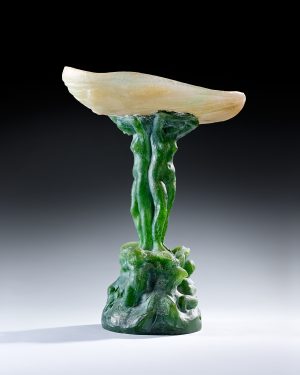
“THE THREE GRACES”, CIRCA 1906
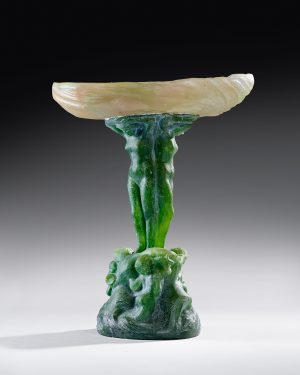
Monumental pâte de verre pedestal dish after a model by Yvonne Serruys representing the Three Graces holdind up a sea shell with green and orange highlights imitating mother-of-pearl, with the
base showing children blowing conch shells
Signed and numbered 940
40 cm. high
The shell: 31 cm. long
Exhibition
Sunderland Museum & Art Gallery, The Art of Glass: Art Nouveau to Art Deco, 17 July-27 October 1996
Bibliography
Gustave Kahn, Le goût moderne, November 1926, pp. 8-11: “Ainsi Mme Yvonne Serruys a donné le modèle d’une coupe haute, à large vasque étendue, exécutée dans les tons blancs du marbre ou la nacrure du coquillage, soutenue par les épaules
de porteurs nus, dont les pieds s’agrippent à un rocher mouvementé, et le verrier a obtenu des épreuves de colorations diverses, distinctes et toutes bien venues”
Victor Arwas, The Art of Glass, Andreas Papadakis, publisher, 1996, full page ill. p. 56
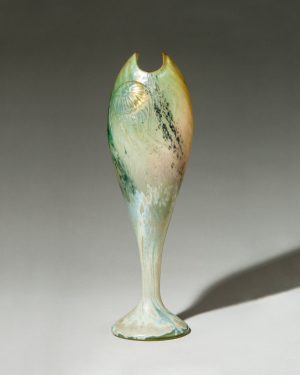
“MEDUSE” VASE, CIRCA 1900
Double glazed footed vase modelled as a fish, internally decorated with powder inclusions, partially iridescent, ornamented with an acid-etched and wheel-carved jellyfish on a hammered background echoing the surface of the water
Wheel-carved signature
30 cm. high
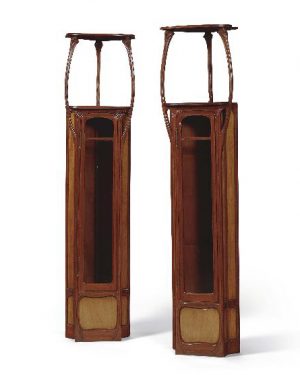
PAIR OF CORNER VITRINES, CIRCA 1895-1899
Mahogany, light mahogany. The frame, the uprights and panels are delicately sculpted with vegetal stylized trims.
The hingers and keys in gilt bronze with a vegetal design.
200 x 46.5 x 42 cm.
A comparable vitrine at the Musée d’Orsay, Paris.
Bibliography
La Revue d’Art, 1ère année, November 1899, illustrated on a photograph.
Provenance
Hotel Guimard built in 1910.
Acquired directly by the merchants Plantin and Blondelin in the 1960s.
Pierre Hebey, Paris.
Cabinet d’expertises Camard, 2001.
Paire de vitrines d’encoignures en acajou massif et acajou blond. Le bâti, les montants et les panneaux sont délicatement sculptés de moulures linéaires végétales stylisées. Elles sont surmontées par trois hautes membrures végétales supportant une tablette polylobée. Les charnières et les clés en bronze doré sont à motif végétal. Vers 1895-1899.
200 x 46,5 x 42 cm
Bibliographie
La Revue d’Art, 1ère année, novembre 1899, reproduit sur une photograpie.
Provenance
Hôtel Guimard, construit en 1910
Acquis directement par les marchands Plantin et Blondel dans les années 60.
Pierre Hebey, Paris
Cabinet d’expertises Camard, 2001
“TROIS TETES” CANDY JAR, MODEL 17F, CIRCA 1900
Stoneware in polychrome enamel depicting three naiades in the waves
Signed A. FINOT and marqued Grès MOUGIN Nancy 17.F
11 x 20 cm.
“DRAGONFLIES” VASE, CIRCA 1895
Cylindrical vase in clear double layered glass, decorated with acid-etched radiant suns and
inclusions of metal oxides; embellished with two polychromatic enamelled dragonflies
Signed underneath by hand with a diamond point
21.5 cm. high; 11 cm. diameter
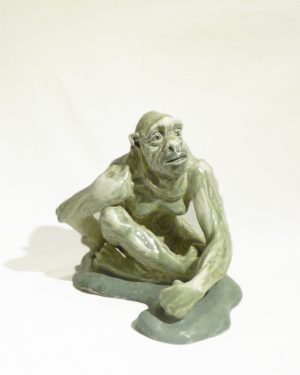
“GUENON”, CIRCA 1900
Grès with a green and white glaze
17.5 cm. high
18.5 cm wide
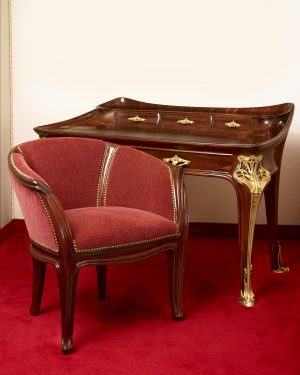
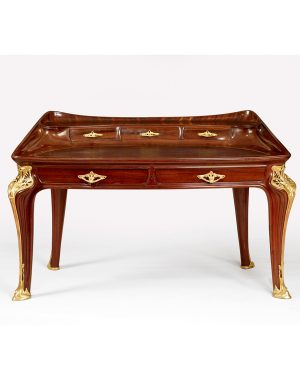
“AUX ORCHIDEES” DESK AND ITS ARMCHAIR, CIRCA 1903-1905
Mahogany, gilt and chased bronze.
The desk: 95 x 151 x 70 cm.
The armchair: 80 x 77 x 65 cm.
Similar example is to be found at the musée d’Orsay and another one in the Ferdinand Neess’ collection at the Wiesbaden Museum.
Exhibition
Société des Artistes Décorateurs, Paris, 1907
Bibliography
Carl Benno Heller, Art Nouveau Meubles, Imprimerie des Arts et Manufactures, Paris, 1990 Berghaus Verlag, the chair is illustrated p. 85.
Roselyne Bouvier, Majorelle, La Bibliothèque des Arts, Paris, 1991, p. 192, n°208, illustration of the base of the desk at the Musée d’Orsay.
Alastair Duncan, Majorelle, Flammarion, 1991, ill. pl. 48 (example at the musée d’Orsay).
Anne-Marie Quette, Le Mobilier Français Art Nouveau 1900, Massin, 1995, ill. p. 43 (example at the musée d’Orsay).
Gabriele Fahr-Becker, Il Modernismo, h.f. Ullmann, 2004, ill. pp. 118 & 119
Radikal Schön Jugendstil und Symbolismus, Die Sammlung Ferdinand Wolfgang Neess, Wiesbaden Museum, 2019, ill. p. 144
Bureau et son fauteuil, modèle dit : “Aux Orchidées”, vers 1903-1905.
Acajou sculpté, courbaril vernis, cuir estampé, bronzes dorés et ciselés.
95 x 151 x 70 cm
Fauteuil : 80 x 77 x 65 cm
Exposition
Société des Artistes Décorateurs, Paris, 1907.
Bibliographie
Carl Benno Heller “Art Nouveau Meubles”, Imprimerie des Arts et Manufactures, Paris, 1990 Berghaus Verlag, chaise repr. p. 85.
Roselyne Bouvier Majorelle, La Bibliothèque des Arts, Paris, 1991, p. 192, n°208, illustration du piétement du bureau du Musée d’Orsay.
Alastair Duncan Majorelle, Flammarion, 1991, repr. pl. 48 (exemplaire du musée d’Orsay).
Anne-Marie Quette, Le Mobilier Français Art Nouveau 1900, Massin, 1995, repr. p. 43 (exemplaire du musée d’Orsay).
Gabriele Fahr-Becker, Il Modernismo, h.f. Ullmann, 2004, repr. pp. 118 et 119.
TRIANGULAR DECORATIVE ELEMENT, CIRCA 1900
Carved and engraved wood, depicting a bather emerging from the water
Length: 21 cm.
CYLINDRICAL VASE, BEFORE 1908
Hand-painted decoration of a Symbolist winter landscape
Signed with the green three-tower mark; B&G; no. 228 and the monogram of the decorative artist (unidentified)
Height: 24.5 cm.
Diameter : 11 cm.
TEA SET, CIRCA 1900
Green and yellow porcelain, comprising: teapot, sugar bowl, milk jug, two cups and saucers.
Model edited by La Maison Moderne