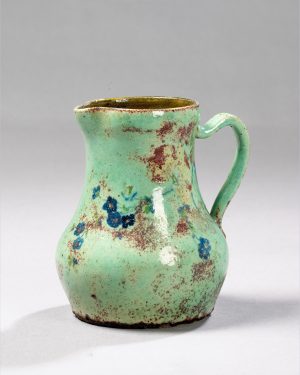
ALBERT DAMMOUSE – PITCHER, CIRCA 1900
PITCHER, CIRCA 1900
Grès with a floral design on a turquoise background with sang-de-boeuf glaze
Signed underneath with the initials and S (For Sèvres)
Height: 11 cm.

Art Nouveau & Art Déco - Gallery in Monaco
Showing 97–120 of 261 results
PITCHER, CIRCA 1900
Grès with a floral design on a turquoise background with sang-de-boeuf glaze
Signed underneath with the initials and S (For Sèvres)
Height: 11 cm.
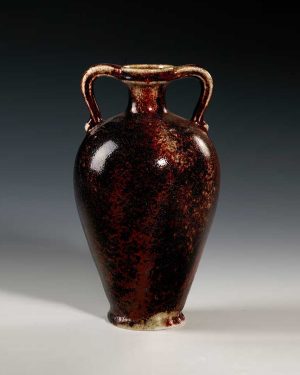
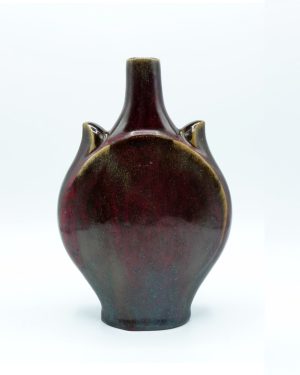
BALUSTER VASE, CIRCA 1900
Enameled Grès with sang-de-boeuf glaze
Bearing the monogram of the artist and located at Sèvres
Height: 16.5 cm.
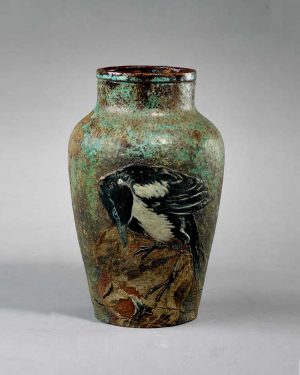
BALUSTER VASE, CIRCA 1900
Enameled grès with a decor of a blackbird and flowers
Signed with the circular stamp. Some firing losses at the base
Height: 27 cm.
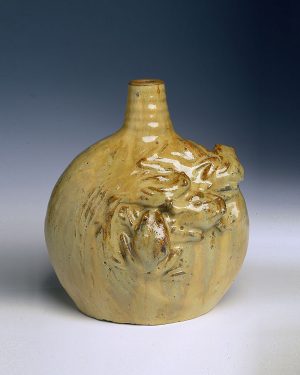
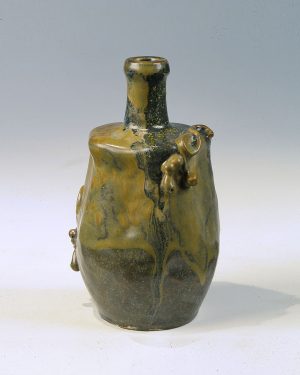
FOUR FROGS GOURD – CIRCA 1900
Rare grès (neck reduced)
Engraved signature, numbered 27/1 and AC
Height: 23 cm.
Exhibition
Paul Arthur, French Art Nouveau Ceramics: An Illustrated Dictionary, Norma éditions, 2015, ill. p. 274
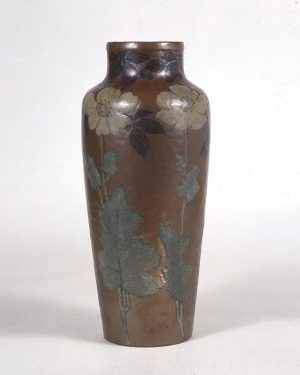
SHOULDERED BALUSTER VASE, CIRCA 1900
Grès with a design in pâte d’émail of anemones and white rowan, yellow-green and brown on a red ocher background
Signature with stamp
Height: 40 cm.
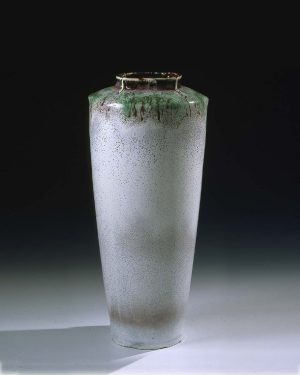
IMPORTANT VASE, CIRCA 1900
Shouldered baluster vase in grès with green and burgundy drippings at the neck on a white
background, the design attributed to Maurice Dufrêne
Interior with sang-de-boeuf drippings
Signed Glatigny and numbered 277
Height: 40 cm.
Bibliography
Paul Arthur, French Art Nouveau Ceramics: An Illustrated Dictionary, Norma éditions, 2015, ill. p. 188
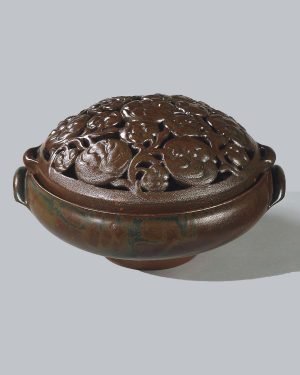
COVERED POT, CIRCA 1900
Grès in slate color with brown and green glaze. The lid is openwork and decorated with fruits and stems
Bearing the monogram of the artist on both parts
Diameter of the base (incl. the handles): 39 cm.
Diameter of the lid (incl. the handles): 36 cm.
Height: 22 cm.
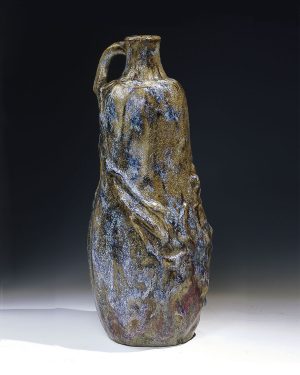
BOTTLE, 1904
Grès in a vegetal shape and a small handle at the neck
Polychrome enamel in shades of green, brown, blue and sang-de-boeuf
Signed in full and impressed with a trefoil mark
The underside with a label : Collection / Gaston Derys / 10 rue Poussin / Paris
Height: 32 cm.
Exhibition
Art Nouveau Belgium / France, Houston & Chicago, 1976, similar model ill. n°266, page 187
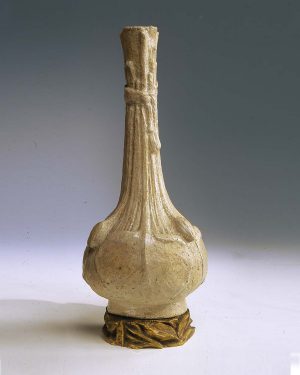
VASE, CIRCA 1900
Vase in the shape of a bottle in light beige grès, with a design of a wreath of flowers and leaves
Signed with the monogram of the artist
The base in gilt bronze, with a design of flowers, signed with the initials of the artist
Height: 33 cm
Bibliography
L. de Fourcaud, Les Arts décoratifs au Salon de 1899 / Les objets d’art (II)
La Société Nationale Revue des Arts décoratifs, 1899, page 330 :
Michel Cazin offers us a beautiful suite of whitish, reddish and dark vases, decorated with a relief of mistletoe, oak, foliage and woven cords
Paul Arthur, French Art Nouveau Ceramics : An Illustrated Dictionary, Norma éditions, 2015, ill. p. 99
SAKE BOTTLE, CIRCA 1900
Grès overlaid with kaki green glaze, mottled yellow ocher and brown drippings
Signed with the monogram of the artist
Height: 16.5 cm.
Bibliography
Paul Arthur, French Art Nouveau Ceramics: An Illustrated Dictionary, Norma éditions, 2015, ill. p. 238
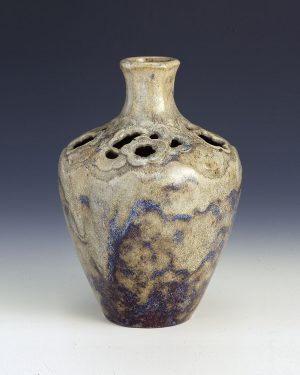
BALUSTER VASE, CIRCA 1905
Gray-beige enamel on a blue background. Openwork design with stylized flowers
Signed E Decœur, engraved trefoil mark under the piece
Height: 22 cm.
Width: 16 cm.
DECORATIVE POT, CIRCA 1889
White glazed earthenware in the form of a Foo dog head
Embossed marks under the base: Modèle et décor déposés, Gallic rooster, E G and Lorraine cross, Émile Gallé, Nancy.
Height: 25 cm.
Width: 22 cm.
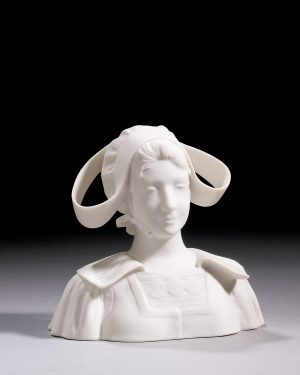
BRETONNE A LA COIFFE, 1904
Biscuit
Signed. Bearing the manufacturer seal for 1904 and the initials HR for Henri Robert (molder)
This model was also edited in bronze
11 x 12 cm.
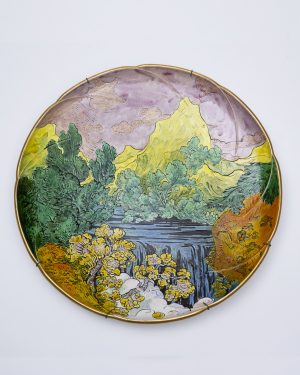
ROUND PLATE LANDSCAPE, CIRCA 1874-1876
Hard-paste porcelain, manufactured at Charles Haviland & Co, in the Auteuil workshop after a design by Félix Bracquemond.
Signed with the B monogram.
Diameter : 50 cm.
Exhibition
La céramique “impressionniste” / Emaux atmosphériques, Musées de la Ville de Rouen, Musée de la Céramique, 2010, similar example ill. pp. 40 & 41 (detail) & page 98, n. 16
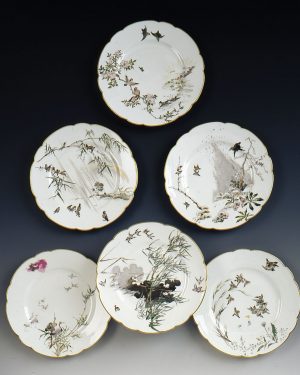
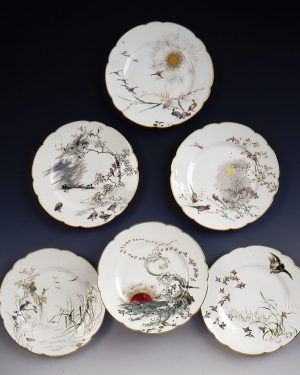
SERVICE PARISIEN, 1876-1878
Complete series of twelve plates titled as:
Le brouillard
Le combat
Le calme
L’effroi
La lune
La neige
La nuit
L’orage
Plein-soleil
La pluie
Le soleil couchant
Le soleil levant
The complete series is in the collection of the Adrien Dubouché’s museum, ADL 2813 à 2824
A plate is in the collection of the Metropolitan Museum of Art, New York, Acquisition number 23.31/18, gift of Monsieur George Haviland, 1923
Exhibition
La porcelaine de Limoges des origines à 1880, musée de l’Evêché, Limoges, 1949
Chefs d’œuvres de la porcelaine de Limoges, musée du Luxembourg, 30 January – 28 April 1996,
n. 130 of the exhibition catalogue
Félix Bracquemond et les arts décoratifs – Du japonisme à l’Art nouveau, Musée national
Adrien-Dubouché, Limoges, puis Deutsches Porzellanmuseum, Selb-Plösberg et Musée départemental de l’Oise, Beauvais, 2005/2006, ill. pp. 92 à 95
Félix Bracquemond et les arts décoratifs – du japonisme à l’Art nouveau,
Musée national Adrien-Dubouché, Limoges, 5 April- 4 July 2005, cat. n°34/1 à 34/12, pp. 86 à 96
Bibliography
Chefs d’œuvres de la porcelaine de Limoges, éditions de la Réunion des musées nationaux, Paris 1996, ill. page 217
Félix Bracquemond et les arts décoratifs, éditions de la Réunion des musées nationaux, 2005,
pp. 88 à 96
Paul Arthur French Art Nouveau Ceramics / An Illustrated Dictionary, Norma éditions, 2015, ill. p.77
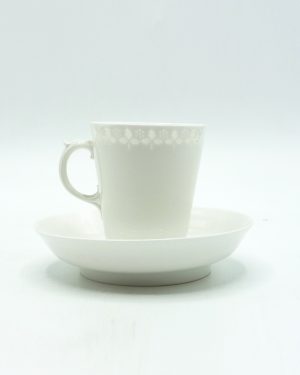
CUP AND SAUCER, 1912
Hard white porcelain, with openwork decoration around the rim
Bearing the Manufacturer’s stampt dated 1912
Height of the cup: 7 cm.
Diameter of the saucer: 11.5 cm.
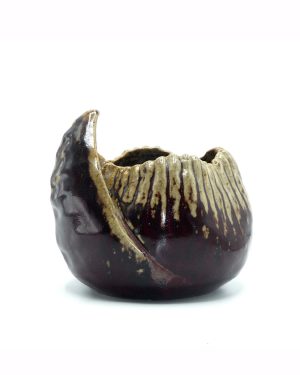
PLANTER, CIRCA 1904-1906
Rouge-sang-de-boeuf enamelled grès
Signed Les Grands Feux de Dalpayrat
Height: 13 cm.
Bibliography
Horst Makus & al., Adrien Dalpayrat – Céramique française de l’Art Nouveau, Arnoldsche, 1998, catalogue n. 107
Provenance
Jean-Pierre Hassler, Switzerland
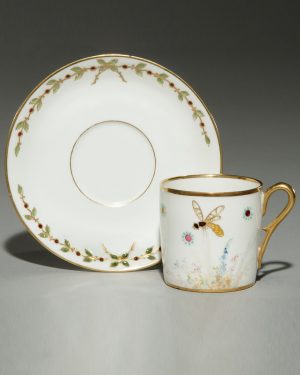
CUP AND SAUCER, CIRCA 1903-1912
White porcelain with translucent polychrome enamels heightened with gold and decorated
with a bee and stylized flowers, the saucer with a design of flowering twigs
Marked on the reverse JPL France in chromium green thick pad color, surrounded by two green laurel branches and inscribed in gold Breveté pour la France et l’étranger/Jean Pouyat/Limoges
Extremely rare example of the highest quality of execution
Cup height: 7 cm
Saucer diameter: 13.5 cm
Bibliography
Edith Mannoni, Porcelaine de Limoges, Massin éditeur, nd, p. 104, for a cup and a saucer by Pouyat
Chefs-d’oeuvre de la porcelaine de Limoges, Musée du Luxembourg, 1996, p. 90, for another cup and a saucer by Pouyat
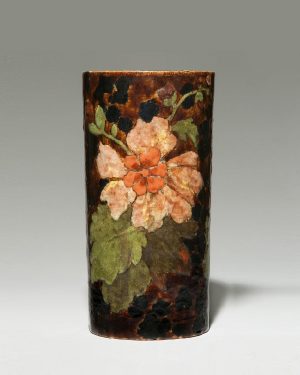
ROLL-SHAPED VASE, CIRCA 1900
Terracotta decorated with barbotine
Floral design of Japanese composition executed by Albert-Louis Dammouse; impressionist technique by Ernest Chaplet excecuted in the Haviland workshop, Auteuil
Bearing the artist’s seal, label from the Roger Marx’s collection and an other old label A la paix …avenue de l’opéra on the reverse
Height: 33.5 cm.
Bibliography
Europäiche Keramik der Jugendstilzeit, Art Nouveau Modern Style, exhibition catalogue,
Hetjens-Museum, Düsseldorf (Allemagne), 1974, p. 50, n. 40 for a similar vase
Félix Marcilhac, Art nouveau 1900, éd. Ouest-France, 1981, ill. p. 25
Anne Lajoix, La céramique en France 1925-1947, éd. Sous le Vent, Paris, 1983, ill. p. 11
Provenance
Collection Roger Marx, Paris
VASE, CIRCA 1900
Grès enameled in shade of bronze with sang-de-boeuf glaze
Numbered 258
27.8 cm. high
Our vase is similar to the gourd kept at the Museum of Fine Arts and Archeology in Besançon, illustrated in the exhibition catalogue Alphonse Voisin-Delacroix ou quand un sculpteur rencontre un céramiste, 24 April – 5 July 1993, n. 31, p. 63
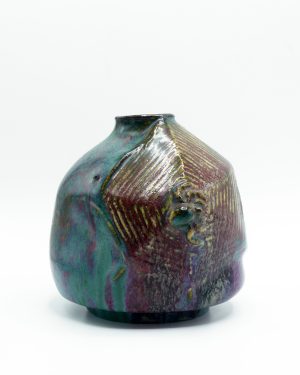
SPIDERWEB VASE, CIRCA 1900
Grès enameled in shades of red, yellow and green glaze
Signed
13 cm. high
Exhibition
Horst Makus & al. Adrien Dalpayrat – Céramique française de l’Art Nouveau, Arnoldsche, 1998, catalogue n. 78
Provenance
Private collection
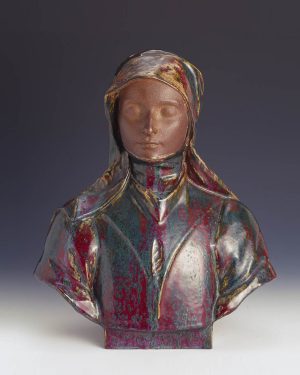
BUST OF A YOUNG WOMAN IN A NUN’S COSTUME, 1893
Grès with red and green glaze
Signed
43 cm. high
This bust would be a posthumous portrait of Eugénie Delacroix, a young cousin of the artist who died prematurely in 1884. The sculptor reportedly used the young woman’s death mask to make the shape of her face.
There are three reduced model (of the plaster model) in enamelled grès, one is at the Musée d’Orsay, signed Voisin-Delacroix
Exhibition
Salon de la Société nationale des Beaux-Arts, Paris, 1893, n°410 (Now at the musée d’Orsay, inventory number DO 1986-83)
Adrien Dalpayrat (1844-1910) – Céramiste de l’Art Nouveau, 1998
Fondation Neumann, Gingins, Switzeland
Kreismuseum Zons, Germany
Musée de l’Ile de France, Sceaux, France
Museum voor Sierkunst & Vormgeving, Gent, Belgium
Bibliography
Horst Makus & al.n, Adrien Dalpayrat – Céramiste de l’Art Nouveau, Arnoldsche, 1998, ill. n°123, p. 162
Provenance
Private collection
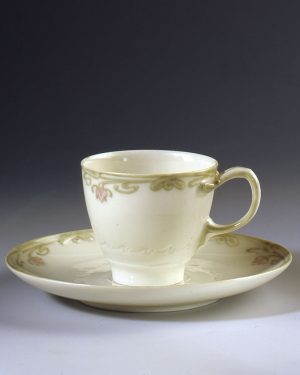
SERVICE CANTON, CIRCA 1904
Coffee cup and saucer designed by Edward Colonna for L’Art Nouveau Bing
Ivory colored porcelain manufactured by GDA in Limoges, with incised Art Nouveau decoration and a design enameled in celadon and rose
Bearing the Art Nouveau Paris green enameled stamp
Cup height: 5.5 cm.
Diameter of the saucer: 13.5 cm.
Bibliography
L’Art Décoratif, April 1901, pp. 12 & 13 : Illustration of other pieces from the service Canton
Art Nouveau Belgium / France, Houston & Chicago, 1976, similar model with a different design,
n. 246, page 178
Chefs-d’œuvre de la porcelaine de Limoges, Musée du Luxembourg, 1996, page 256 : Illustration of a cup and its saucer, Canton model
Edith Mannoni, Porcelaines de Limoges, Massin éditeur, sd., page 90 : Illustration of three pieces from the service Canton
Gabriel Weisberg, Art Nouveau Bing – Paris style 1900, Harry N. Abrams, inc., New York, 1986, pp. 197 & 200: Illustration of other pieces from the service Canton
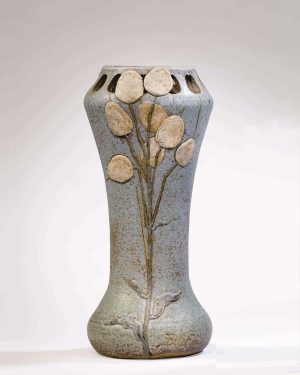
VASE, CIRCA 1900
Grès with gray blue mottling, decorated with honesty leaves applied on both sides
Signed MILLET / Sèvres under the base and Belet sc lower right
28 cm. high
Bibliography
Paul Arthur, French Art Nouveau Ceramics: An Illustrated Dictionary, Norma Editions, 2015, ill p. 53