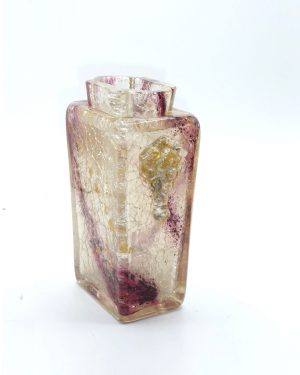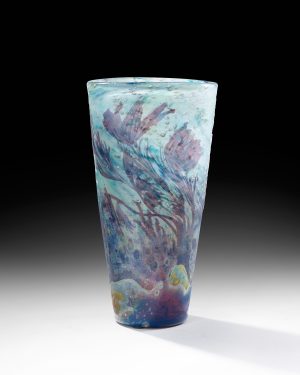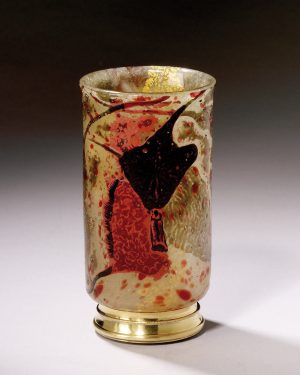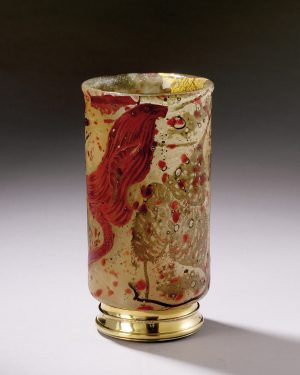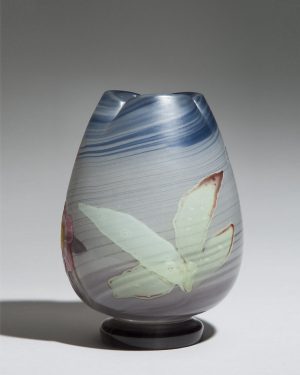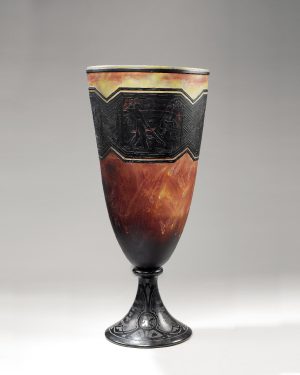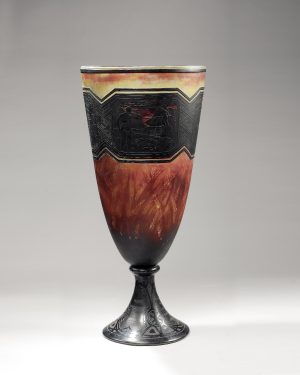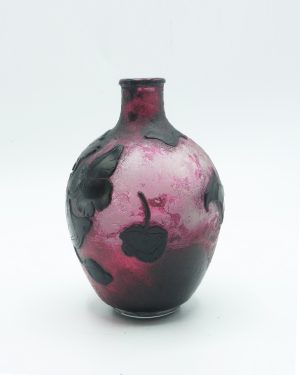
ERNEST LEVEILLE – VASE, CIRCA 1900
VASE, CIRCA 1900
Blown and crackled glass with red glass powder inclusions
Height: 17.5 cm
Unsigned. Probably a design by Eugène Rousseau
Provenance
Stern family
Then by descent

Art Nouveau & Art Déco - Gallery in Monaco
Showing 1–24 of 108 results
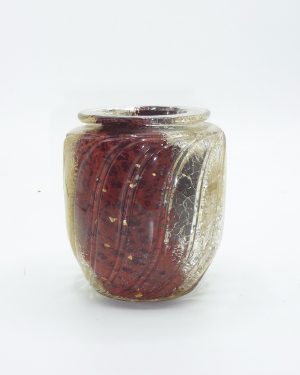
VASE, CIRCA 1900
Blown and crackled glass with red glass powder inclusions
Height: 17.5 cm
Unsigned. Probably a design by Eugène Rousseau
Provenance
Stern family
Then by descent
“A TETE DE CHIMERE” VASE, CIRCA 1885
Crackled glass with glass powder inclusions, with applied side motifs depicting chimeras
Height: 20.5 cm.
Unsigned. This model was originally created by Eugène Rousseau, who did not always sign his works. It also exists in a 26 cm version with engraved chimeras and rabbit. (L’Art du verre en France, p. 35)
Bibliography
B. Klesse et H. Mayr, Glas vom Jugendstil bis heute, Sammlung Gertrud und Dr. Karl Funke-Kaiser, Cologne, 1981, p. 333, n. 243
G. Cappa, L’Europe de l’art verrier, des précurseurs de l’art nouveau à l’art actuel, 1850-1990, Liège, 1991, p. 393, n. 702
Provenance
Stern family
Then by descent
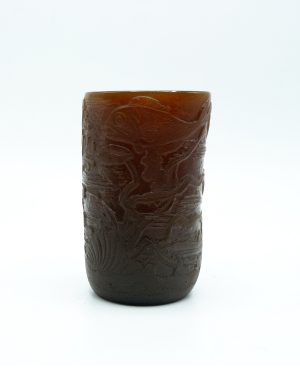
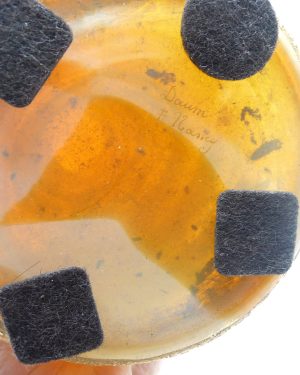
VASE, CIRCA 1900
Roller vase in thick, partially opalescent amber glass, decorated with fish and
seaweed deeply wheel-engraved
Signed E. Léveillé and located on the reverse
Height: 10.5 cm.
Bibliography
Vases with similar decoration and technique:
Janine Bloch-Dermant, L’Art du Verre en France, Lausanne, 1974, p. 30
Glas des Art Nouveau – Die Sammlung Gerda Koepf, Prestel 1998, page 81, ill. 4
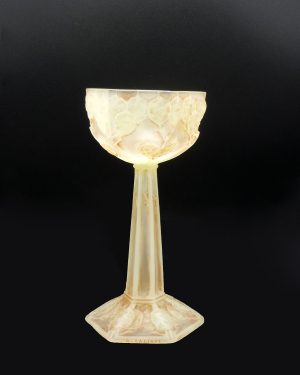
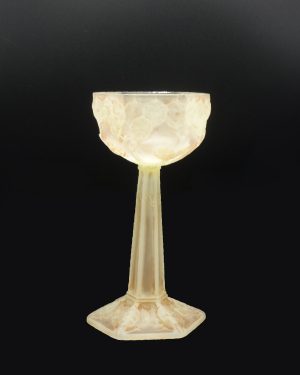
“MONNAIE DU PAPE” CHALICE, 1904
A model of the same shape, decorated with a design of anemones, is in the collection of the Gulbenkian Museum, Lisbon, inventory no. 1264
This piece was not referenced in the first three editions of the Catalogue Raisonné by Félix Marcilhac. It was subsequently listed under CP2bis (with the description published under CP3quater wrongly attributed to a third party)
Provenance
Formerly in the collection of one of René Lalique's collaborators
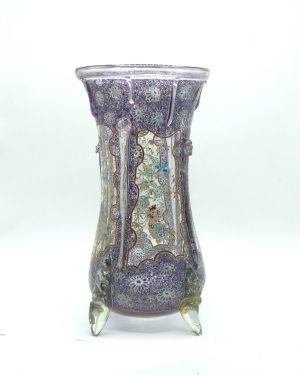
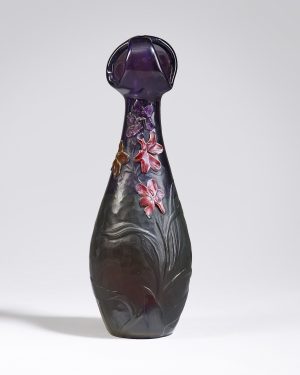
DIABOLO VASE, CIRCA 1900
Glass, with four applied feet. Enamel decoration of daisies and four medallions featuring fantastical birds
Unsigned
One foot restored
Height: 32.5 cm
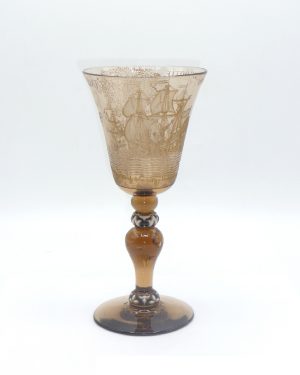
DECORATIVE VASE, CIRCA 1878-1884
Smoked glass, decorated with an historicising design engraved in intaglio and highlighted with gilding, the two rings decorated with polychrome opaque enamels
Bearing two inscriptions engraved around the rim: T Weilvaren” and “Van de Negoothie
Unsigned
Height: 23.5 cm – Diameter: 11 cm.
The subject chosen by Gallé is Mercury and Neptune watching over the fate of a rich ship, while the inscriptions may be translated as “twelve years of trade”
A related model is currently held in the collections of the Musée d’Art Moderne de Paris (inv. no. OAO 999)
Bibliography
Françoise Thérèse Charpentier & Philippe Thiébaut, Gallé, exhibition catalogue, Musée du Luxembourg, 29 November 1985 to 2 February 1986, Éditions RMN, 1985; a similar model is ill. p. 162
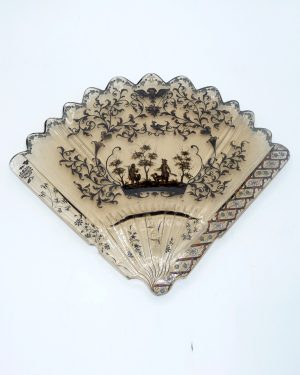
FAN SHAPED VIDE-POCHE DISH, 1874
In smoked glass, enamelled with a painted decoration in blackish-brown and polychrome enamels, with intertwined foliage and a central hunting scene depicting hunters, a dog and game
Signed E. Gallé and dated 1874
30 × 33.5 cm.
RARE VASE, CIRCA 1892-1895
Double acid-etched glass with a design of grasshoppers, flowers, insects, and an enameled butterfly, highlighted with gold
Signed
Height: 29 cm.
Exhibition
Similar model at the Kitazawa museum
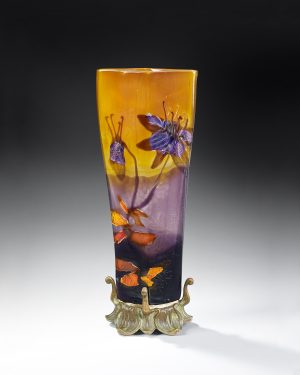
CONICAL VASE, 1898
Multilayered and wheel-carved conical vase with faceted corners in amber, purplish-blue and red marquetry glass, internally decorated with columbines on a background with silver foil inclusions, acid-etched, the original bronze base in the shape of leaves and spurs
Signed and dated 1898
26.1 cm. high
Exhibition
Société Nationale des Beaux Arts, 1898
Wood One Museum of Art, Hiroshima, Japan, 2005, n.33, ill. p. 36 in the exhibition catalogue
Emile Gallé – Nature and Symbol / Le Langage des Fleurs et des Choses Muettes, 16 January – 10 April 2016, Tokyo Metropolitan
Teien Art Museum; 24 April – 5 June 2016, Utsunomiya Museum of Art, n. 069, ill. p. 90
Bibliography
Revue des Arts Décoratifs, 1898, ill. p. 148
Renate Ulmer, Art Nouveau Symbolismus und Jugendstil in Frankreich, Arnoldsche, 1999, ill. p. 319, n. 318
Emile Gallé et le verre, la collection du musée de l’Ecole de Nancy, Ed. Somogy, Paris, 2004, similar example ill. p. 164, n. 280
Provenance
Daimaru Museum, Japan
Other examples of this design are owned by important museums worldwide:
Kitazawa Museum of Art, Japan
Kunstmuseum, Dusseldorf (Collection Gerda Koepf), Germany
Suntory Museum, Japan
Musée de l’Ecole de Nancy, Nancy, France
Budapest Museum of Applied Arts, inv. n. 55.284, Hungary
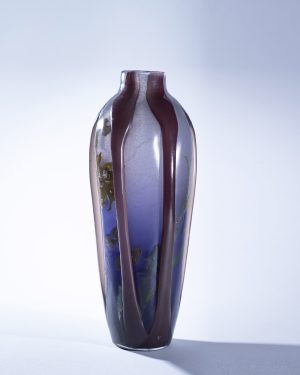
“IRIS” VASE, CIRCA 1900
Multilayered glass vase decorated with blooming water iris in glass marquetry,
some elements wheel-cut, with six vertical hot-applied elements
Signed with a double line
Exhibition
The model was exhibited at the 1900 Paris Universal Exposition,
displayed in the Les Granges showcase
Our vase was shown at the Fine Arts Exhibition in Mulhouse in 1911, no. 14, p. 90
It was also included in the Gallé exhibition at the Musée du Luxembourg in Paris from 29 November 1985 to 2 February 1986
Bibliography
Émile Nicolas, M. Émile Gallé at the 1900 Exposition, in La Lorraine, 18th year, no. 11,
December 1900, p. 164, for a similar example with a dragonfly
Roger Marx, La décoration et les Industries d’Art à l’Exposition de 1900, 1901, p. 107
La Revue Lorraine Illustrée, no. 3, 1906, p. 106
Bulletin de la Société Industrielle de Mulhouse, 1911, p. 4
A similar example was sold at Christie’s Geneva on 16 November 1981 under lot no. 228 (sold for 230,000 Swiss francs plus fees to Andrée Vyncke)
Georges de Bartha, Gallé, le verre, Bibliothèque des arts, Paris, 1985, p. 105, for a similar model
Françoise Thérèse Charpentier, Philippe Thiébaut, Gallé, exhibition catalogue, Musée du Luxembourg, Paris, 29 November 1985 – 2 February 1986, Ministry of Culture, Éditions de la Réunion des musées nationaux, Paris, 1985, p. 212
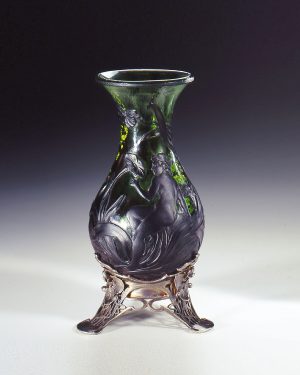
EXCEPTIONAL VASE, CIRCA 1900
Multilayered glass with with gold leaf inclusions and blue and brown powder streaks, overlaid in black,
hammered and carved with a decor of a woman and reeds.
The mount in silver with a design of leaves on an openwork background.
Silver marks.
15.4 cm. high
VIDE-POCHE, CIRCA 1900
Pâte de verre
Signed and numbered 515
Height: 9 cm.
Length: 12.5 cm.
“ANEMONE” VASE, CIRCA 1897-1900
Conical multilayered vase, internally decorated and engraved
Signed
21.5 cm. high
Exhibition
Emile Gallé, Exhibition in six Japanese museums, 2000-2001, n. 45 in the exhibition catalogue, ill. pp. 90 and 91 (example at the Juken museum)
Bibliography
A similar 27 cm. high vase in the collections of Juken Museum of Art, Yoshiwa, prefecture of Hiroshima, Japan
Another, 28,2 cm. high, is in the collection of Her Royal Highness Margrethe II, the Queen of Denmark
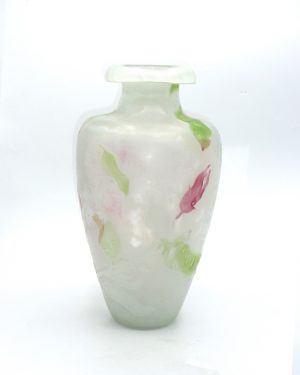
“LES BLANCS SOLEILS D’AUTOMNE” OR “CHANT D’AUTOMNE” IMPORTANT VASE, CIRCA 1900
Glass marquetry in shades of green and pale pink against an opalescent white ground
Decorated with swamp magnolia blossoms, acid-etched and finely wheel-carved
Height: 34.5 cm.
Exhibition
Smaller-size model, exhibited at the 1892 Salon. The smaller version of this model is preserved in the collections of the Musée d’Orsay under identification no. 33270 and inventory no. PHO 1986 71 157
Bibliography
Louis de Fourcaud, Émile Gallé, in the series Les Artistes de tous les temps, published by Librairie d’Art Ancien et Moderne, Paris, 1903; the smaller version of the model is illustrated on page 27 and titled Les Blancs Soleils d’Automne
Revue des Arts Décoratifs, seventeenth year, 1 January 1897; the smaller version of the model is illustrated on page 342 and is also titled Chant d’Automne
Provenance
The vase was commissioned from Émile Gallé by Félix Crousse (1840–1925) and subsequently remained in the family by descent.
Born on 2 October 1840 in the Boudonville district of Nancy, François Félix Crousse was the son of Louis Crousse, a gardener, and his wife Françoise Morel. He attended the Imperial Lycée of Nancy from 1850 to 1855 before undertaking a horticultural apprenticeship that lasted approximately ten years, notably with Auguste Calot in Douai.
He quickly distinguished himself through his work on the ivy-leaved geranium, which he successfully improved, as well as on various other flowering plants, including chrysanthemums, cyclamens, and herbaceous peonies, for which he developed nearly eighty new cultivars. Crousse achieved international renown as one of the foremost specialists in tuberous begonias.
Closely associated with several artists of the École de Nancy—among them Jacques Gruber, Ernest Bussière, and above all Émile Gallé—he paid tribute to Gallé by giving his name to several of his floral creations, particularly peonies and begonias.
In 1877, together with Victor Lemoine, Émile Gallé, and Léon Simon, he founded the Central Horticultural Society of Nancy (Société Centrale d’Horticulture de Nancy), whose development he actively supported. He encouraged the creation of a society bulletin, which he edited for a time before entrusting its management to Gallé, and later served as vice-president of the organization.
Félix Crousse gained particular recognition at the great international exhibitions. He was awarded a Gold Medal at the 1878 Paris Exposition for his peonies and a Silver Medal at the 1889 Paris Exposition for his begonias.
This is typical provenance text in an auction catalogue: it establishes a direct historical connection between the original commissioner, the celebrated horticulturist Félix Crousse, and Émile Gallé, while emphasizing the vase’s uninterrupted descent within the family.
“LA GIROFLEE DE MURAILLE”, CIRCA 1900
Multilayered glass with four applied and wheel-carved flowers, gold leaf inclusions, partly hammered
Engraved signature
21 cm. high
Only one other example is known to exist
Provenance
According to previous owners, this vase was acquired at auction in Versailles around 1970 as therefore could be part of a group of vases sold by Emile Gallé’s descendants
VASE, CIRCA 1900
Engraved marquetry with a design of ray and aquatic flora
Powder inclusions and inclusion of shattered gold foils, hammered with small facets
Silver gilt mount with French Minerva mark
Vertically engraved signature
17 cm. high
No similar example known to exist
Bibliography
For the same shape of the mounted vase: Tsuneo Yoshimizu, The Glass Arts of Emile Gallé, Gakken 1985, n.144; without the mount n. 143 and 184
Georges de Bartha, Glass by Gallé, Thames & Hudson Ltd, 1984, p. 59, n. 61 (EU 1900)
AIGUIERE AUX IRIS, 1893
Multilayered glass, partly hammered with small irregular facets and wheel-carved decor of iris flowers
Height: 22 cm.
Most likely blown and engraved in Meisenthal then wheel-carved in Nancy
Designed to be mounted in silver, an example was acquired directly from Emile Gallé in 1893 by the Union Centrale des Arts Décoratifs, the current Musée des Arts décoratifs, inventory number 7775. The mount is by Joseph Joindy, chased by Francis Peureux who was the main silver chaser at the Maison Boucheron. Our example is the unmounted one that remained in Emile Gallé’s family and no other example known to exist.
In his book L’Oeuvre de verre d’Emile Gallé, copyright 1998 Editions Messene, Paris,
François Le Tacon illustrates a ewer in red and black multilayred glass, that he dates 1893 and which is located in the castle museum of Boulogne-sur-Mer, inventory n. 750, height: 25 cm.; We read: “A l’opposé, une cruche de 1893 (fig.62), sans caractère symbolique, est un objet intrinsèquement décoratif. Soufflée et gravée à Meisenthal à l’acide, puis reprise à la roue à Nancy, elle était destinée à être montée à Paris sur argent doré, comme l’exemplaire du musée des Arts décoratifs. Elle est en cristal triple couche : une interne translucide, une intermédiaire noire foncée et une externe rouge. L’opposition violente entre le noir et le rouge donne à cette pièce un aspect particulier, encore souligné par l’agressivité de la gravure qui s’apparente beaucoup à une taille. La monture en argent ciselé et doré, de style rocaille, avec deux serpents s’enroulant autour de l’anse, plutôt de style Art nouveau, accentue encore les oppositions. La pièce parisienne, à décor d’iris, a été achetée directement à Gallé par le musée; celle de Boulogne, à décor de lys, appartenait à Charles Lebeau”.
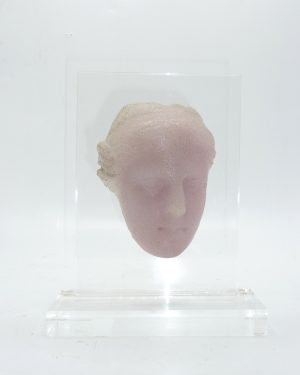
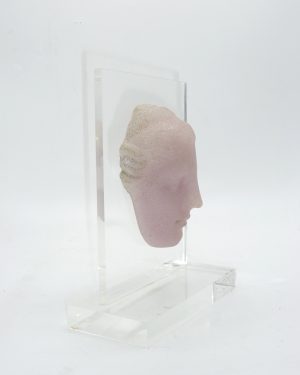
FACE, CIRCA 1905
Pâte de verre
Signed
Mounted on a plexi base
Total height: 21 cm.
“FUSCHIA” COUPE, CIRCA 1908
Pâte d’émail mauve, green and orange brown on a caramel background. Design in shallow relief.
Signed with the circular seal and numbered BK 2. Has its original box.
Height: 5.7 cm.
Diameter: 11.7 cm.
Bibliography
Véronique Ayrolles, François Décorchemont Maître de la pâte de verre, Editions Norma, Paris 2006, ill. p. 40, p. 227
Exhibition
Musée du Verre François Décorchemont, Conches-en-Ouches, François Décorchemont – L’alchimie de la matière, de la couleur et de la lumière, 24 May 2025 – 30 November 2025
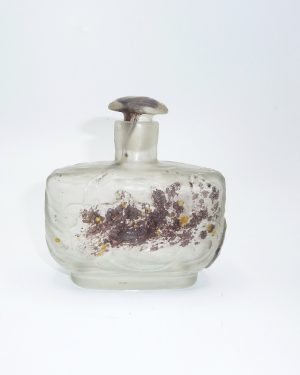
BOTTLE AND STOPPER
Bottle and stopper, of flattened shape, in thick frosted glass with powder and gold foil inclusions,
overlaid and entirely chased with a bat on each side on a background featuring a moon crescent and waves.
Original stopper with hammered top and foil inclusions.
Incised signature on the side.
10.5 x 11 x 4.5 cm.
Bibliography
Le Modern Style, page 129
Provenance
Formerly in the collection of Maria de Beyrie, Paris
Private collection, Paris
Acquired from the above
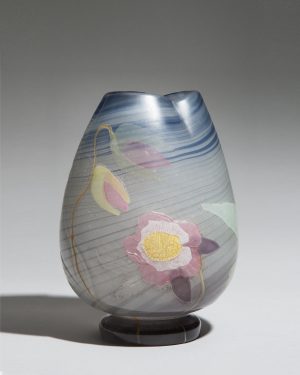
VASE, CIRCA 1900
Footed egg shaped glass marquetry vase with a pinched neck and a design of finely carved water lilies
Similar example at the Kitazawa Art Museum, Suwa, Japon
Height: 19.5 cm.
Exhibition
Emile Gallé – Nature and Symbol / Le Langage des Fleurs et des Choses Muettes,
16 January – 10 April 2016, Tokyo Metropolitan Teien Art Museum; 24 April – 5 June 2016, Utsunom
Bibliography
Alastair Duncan, The Paris Salons Volume IV: Ceramics & Glass, ill. on the cover page and p. 40.
“HOMMAGE A CAMILLE CAVALLIER” LAMP, 1924
Blown and engraved glass
Inscribed: Charlon/Pont à Mousson/Camille Cavallier/Hommage/des Conseillers/du Commerce Extérieur/de la Région de l’Est/1924″ et “Métallurgie/Pont à Mousson/1856/Foug/1905 Au Boue/1905/S’Estienne du Rouvray/1915
Height: 74 cm.
“Ce magnifique vase est la réplique de celui qui a été offert officiellement à Camille Cavallier, président-fondateur des Fonderies de Pont-à-Mousson, en 1924. Sur un fond symbolique de blés mûrs au temps de la moisson, quatre médaillons reproduisent dans une dominante rougeoyante qui leur convient, des scènes d’atelier, depuis la mine jusqu’à la forge. Tous ces motifs sculptés finement dans le verre, sont les témoins de la qualité exceptionnelle des graveurs sur verre de cette époque. Leur travail n’était pas exempt d’aléas, et si ce vase n’est qu’une réplique de l’original, quoique terminé, c’est qu’il est légèrement fêlé. Au cours des derniers coups de roue, une crique s’est déclarée inopinèment, rendant nécessaire la reprise à zéro du travail sur une autre pièce en attente, qui ne dut qu’à un tour de force d’être prête à temps. Le principal auteur du travail était le célèbre H. Racadot”. (Notice of Noël Daum in the catalogue of the exhibition at the Musée des Beaux-Arts de Nancy)
Exhibition
DAUM Cent ans de verrerie d’art “trois styles”, 3ème exposition, March 1979 – March 1980, musée des Beaux-Arts de Nancy, n. 16 in the exhibition catalogue
Bibliography
Noël Daum, Daum Maîtres Verriers, Edita Denoël, 1980, ill. p. 108
Clothilde Bacri, Daum, Paris, 1992, ill. p. 152
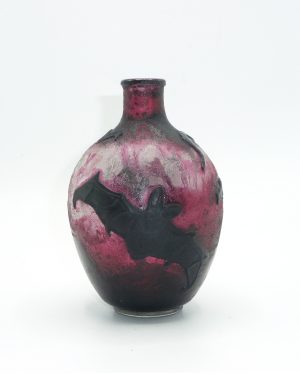
BALUSTER VASE, CIRCA 1900
Baluster vase with small upright neck.
Clear glass overlaid in oxblood acid etched and entirely wheel carved featuring a large and
two small bats on a frosted background.
Wheel cut signature heightened in gold with the Cross of Lorraine on a hammered background.
Height: 15 cm.
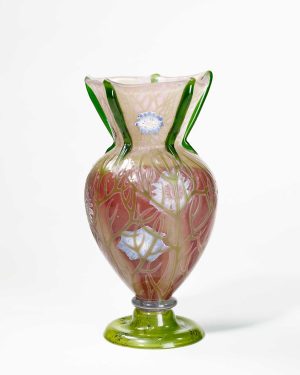
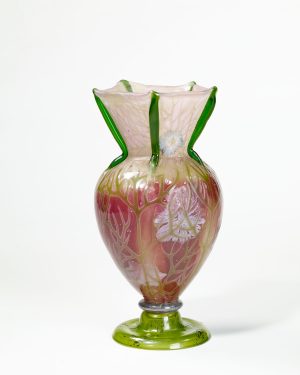
“LA NIGELLE DES PRES”, AN IMPORTANT FOOTED VASE, CIRCA 1900
Marquetry and finely wheel-carved glass, the pink surface overlaid with white
and blue flowers and an applied motif of brown branches
Engraved Gallé
20.5 cm. high
No other example of this design is known to exist
Exhibition
Exposition Universelle, 1900, Paris
Bibliography
Gallé, exhibition catalogue, musée du Luxembourg, 29 November-2 February 1986,
éditions de la Réunion des Musées Nationaux, ill. p. 54 in the “Les granges” vitrine