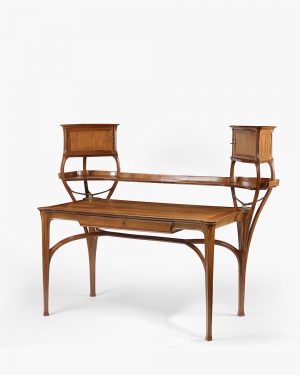
DESK, CIRCA 1900
Sculpted pear wood and gilt bronze
131 x 161 x 88 cm.
Exhibition
Société Nationale des Beaux-Arts, 1897 for a variation of this design
Bibliography
Art et Décoration, April1897, the model without the side elements ill. p. 107 Der Modern Stil, Julius Hoffmann éditeur, 1899,
vol. I, ill. pl. 64, for the one exhibited at the Société Nationale des Beaux-Arts Der Moderne Stil, 1903, ill. pl. 82
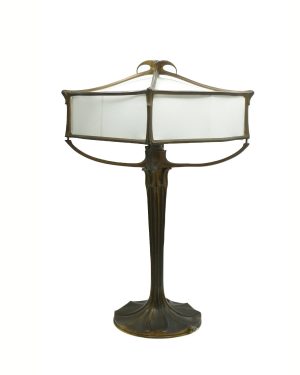
CEILING LIGHT
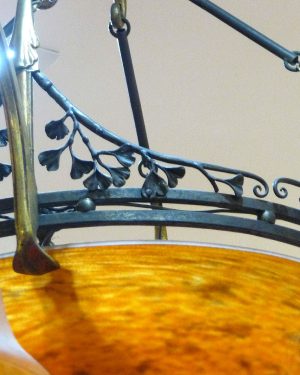
Bronze and wrought iron ceiling light decorated with Ginkgo biloba motifs, featuring four arms supporting Daum tulip shades in milky-white mottled glass, and a central Daum glass bowl
The mount is signed E BRANDT; the glass shades are wheel-engraved and signed Daum Nancy France, with the Cross of Lorraine
Total height: 104 cm.
Width: 69 cm.
CEILING LIGHT
Bronze and wrought iron ceiling light with four arms supporting orange tulip shades by Daum, and a central orange glass bowl by Daum
The ceiling light is signed: E. Brandt
The tulip shades and the bowl are signed
Height: 63 cm.
Total diameter: 67 cm.
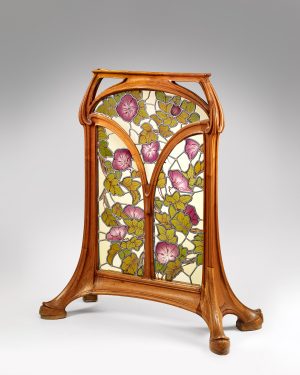
FIRESCREEN, CIRCA 1900
Carved walnut with inlaid panels of etched glass with clematis flowers and leaves.
123.5 cm. high; 104.5 cm. wide
Bibliography
Frédéric Descouturelle, Eugène Vallin, Menuisier d’Art de l’Ecole de Nancy, Imprimerie Moderne, Pont-à-Mousson, 1998, a variation of the design ill. p. 209
Victor Arwas, Art Nouveau: The French Aesthetic, Andreas Papadakis publisher, 2002, ill. p. 320
Ecran de cheminée en noyer massif mouluré encadrant un panneau de Gruber en verre de couleur gravé à décor de clématites. Hauteur : 123,5 cm Largeur max : 104,5 cm
Bibliographie Frédéric Descouturelle, Eugène Vallin, Menuisier d’Art de l’Ecole de Nancy, Imprimerie Moderne, Pont-à-Mousson, 1998, forme du modèle reproduite page 209. Victor Arwas, Art Nouveau – The French Aesthetic, Andreas Papadakis publisher, 2002, rep. p. 320
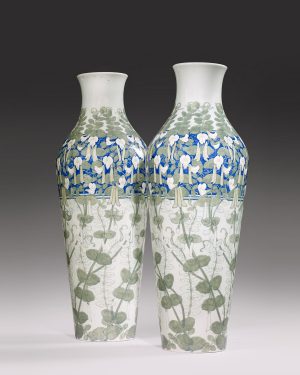
“Vase de Creusot”, 1898
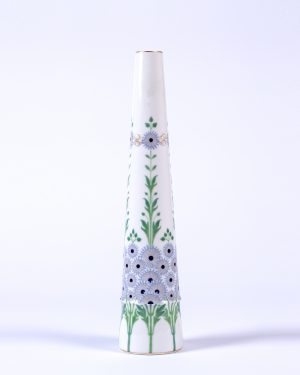
White porcelain (pâte dure nouvelle) glazed in shades of green and yellow with a decor of irisis
Signed in gold L. MIMARD and bearing the manufacturer’s stamp for 1898
and the decoration stamp for 1901
Height: 45 cm.
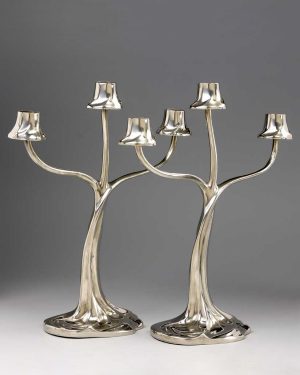
PAIR OF CANDELABRAS
Silvered pewter
Height: 28.5 cm.
Bibliography
Illustrated in the catalogue of La Maison Moderne The Modern Style, J. Hoffmann Jr, p. 221 Le Style Moderne: L’Art Appliqué, Revue Internationale, Première Année, H. Laurens – éditeur, 1903-1904, ill. pl. 92
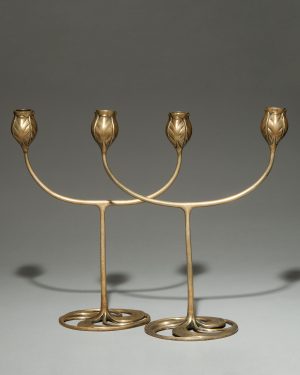
PAIR OF CANDELABRAS, CIRCA 1900
Gilt bronze with original patina
Signed
33 cm. high
Bibliography Documents sur l’Art Industriel au XXème siècle, edited by La Maison Moderne, Paris, Les appareils d’éclairage, ill. p. 7, under the reference “Candélabre n°1561-1”
THEOPHILE HINGRE
LOUCHET, Chaser
Silvered bronze, featuring two dragonflies facing each other on a sprig of lily of the valley
Signed T. HINGRE and LOUCHET
9.8 cm. high
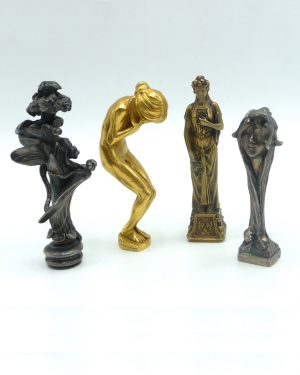
GUSTAVE GURSCHNER
LA MAISON MODERNE “MEDITATION” SEAL, CIRCA 1900
Gilt bronze
Height: : 9.5 cm.
Bibliography Documents sur l’Art Industriel au vingtième siècle. Reproductions photographiques des principales œuvres des collaborateurs de La Maison Moderne, La Maison Moderne, Paris 1901, La Sculpture,
ill. p. 14, seal, n. 724-1
JOE DESCOMPS
SUSSE FRERES “TANAGRA” SEAl, CIRCA 1900
Gilt bronze
Signed Joé Descomps and Susse Fres
Height: 9.8 cm.
FRENCH “LES VIOLETTES” SEAL, CIRCA 1900
Silver
With French Minerva mark
Height: 8 cm.
Bibliography
An identical model in gilt bronze is illustrated in Les Sceaux, Empreintes du Pouvoir, Roberto Lucio Rosaia, éditions Langlaude, p. 176
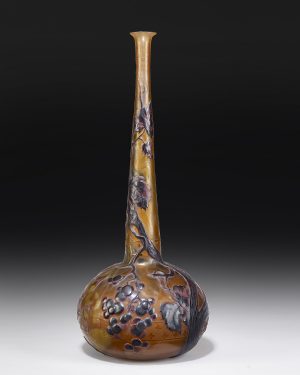
“VIGNE” VASE, 1895
Moulded, blown, internally decorated glass, overlaid in black, deeply acid-etched
and wheel-carved, applied decoration
Gilt intaglio signature Daum Nancy with the cross of Lorraine, inscribed Mo and Fecit, dated 1895,
signed Gruber Del and J. Marchand
46 cm. high
Jacques Gruber was the most prominent designer working at Daum between 1893 and 1897.
From 1893, he designed vessels intended for national and international exhibitions,
most of which were unique pieces. He is most probably the author of the shape that appeared
in 1894 and of which very few examples are known, more or less all equal in height and with
various designs of poppies, thistles, sweet peas, and peacock feathers.
Most of them are presently in museums. We were unable to locate a similar example in that particular height.
Jules Marchand was the principal engraver at the Daum workshop. Working with an oil lamp, he ended his life blind
“L’HOMME QUI COURT APRES LA FORTUNE”, LES FABLES DE LA FONTAINE, 1886,
after Gustave Moreau
Black engraving on Japan paper (crease marks)
Signed G. Moreau, in progress for the proprietors M. and Mme Bounod Valadon and 5ème tirage
27.5 x 21.5 cm.
“LE SONGE D’UN HABITANT DU MOGOL”, LES FABLES DE LA FONTAINE, 1886,
after Gustave Moreau
Black engraving on Japan paper (crease marks)
Signed G. Moreau, in progress for the proprietors M. and Mme Bounod Valadon and 5ème tirage
27.5 x 21.5 cm.
“LA TETE ET LA QUEUE DU SERPENT”, LES FABLES DE LA FONTAINE, 1886,
after Gustave Moreau
Black engraving on Japon paper (crease marks)
Signed G. Moreau, in progress for the proprietors M. and Mme Bounod Valadon and 5ème tirage
28.5 x 19.5 cm.
“LE LION AMOUREUX”, LES FABLES DE LA FONTAINE, 1886, after Gustave Moreau
Black engraving on Japon paper (crease marks)
Signed G. Moreau, In progress for the proprietors M Mme Bounod Valadon and 3ème tirage
26.5 x 19.5 cm.
VASE, CIRCA 1900
Red flamed ceramic, with an openwork ‟whiplash” mount at the base in the style of van de Velde, and the neck designed in the same spirit
With French Minerva mark and silversmith mark
Height: 14 cm.
“CRANE AND REEDS” FLOOR LAMP, CIRCA 1900-1905
Bronze and patinated metal
Height: 175 cm.
This work, likely of Japanese origin, is a masterful example of the decorative appeal of bronze cranes around 1900, following the Western importation of sacred animals. Impressive in scale and retaining its original patina, our floor lamp is a brilliant illustration of the integration of fauna and flora into a lighting fixture in keeping with contemporary taste.
Other examples of this type of floor lamp are known: one is held in the Gillion Crowet Collection (Belgium), and another, from the Rispal donation (France, 2005), is part of the Musée d'Orsay collections.”
VASE “DE BOUGIVAL”
Porcelain with polychrome decoration of stylized flower stems. The neck and the base are highlighted with fine gold
Bearing the S 1909 stamp and decoration stamp for 1910. Bearing the monogram of the decorative painter Léon PELUCHE
Height: 35.5 cm.
SMALL BOWL, 1898
Plique-à-jour enamel and silver, resting on four feet
Signed CG Hallberg Stockholm 1898
10.5 cm. diameter
VIKING LONGSHIP OPEN SALT
Plique-à-jour enamel and silver
Signed Marius Hammer Bergen
A similar cup at the Musée des Arts décoratifs in Budapest.
9 cm. long
Both items made at Marius Hammer in Bergen and retailed by CG Hallberg in Stockholm.
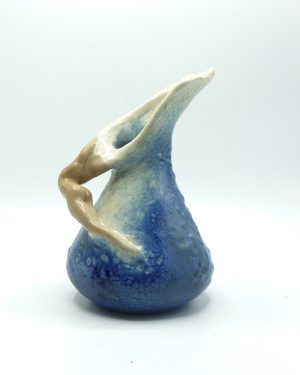
“ALGUES” JUG, CIRCA 1900
Patinated stoneware with seaweed decoration in low relief, the handle shaped like a naiad
Numbered 112 J in relief under the base and Mougin / Nancy
Height: 23 cm.
Bibliography
Jacques Peiffer, Les frères Mougin / Sorciers du grand feu, éditions Faton, Paris 2001, ill. p. 47