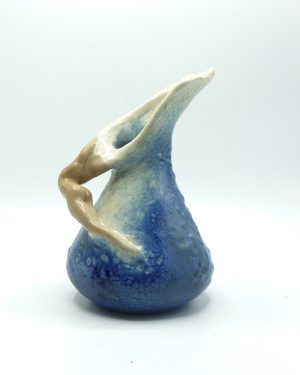
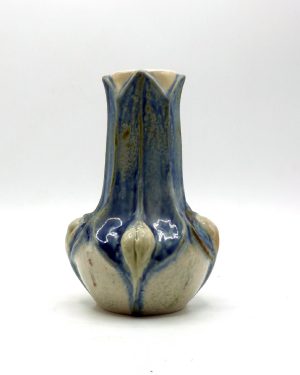
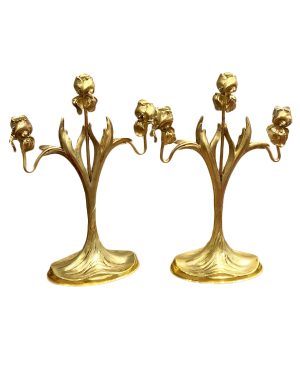
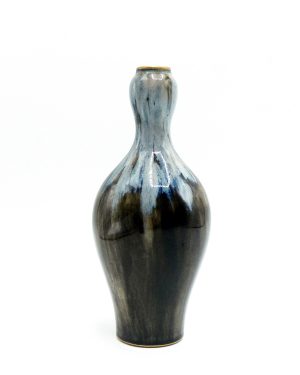
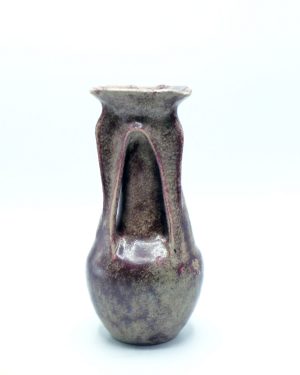
“ALGUES” JUG, CIRCA 1900
Patinated stoneware with seaweed decoration in low relief, the handle shaped like a naiad
Numbered 112 J in relief under the base and Mougin / Nancy
Height: 23 cm.
Bibliography
Jacques Peiffer, Les frères Mougin / Sorciers du grand feu, éditions Faton, Paris 2001, ill. p. 47
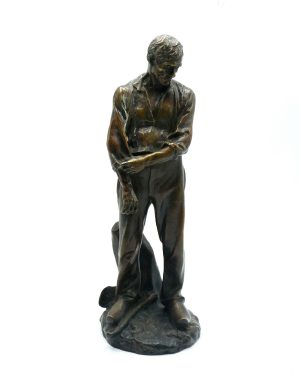
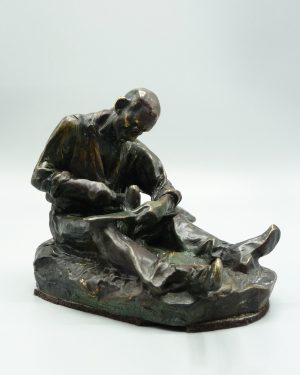
“LE PAYSAN REMONTANT SA MANCHE” OR “LE TRAVAIL”
Bronze sculpture with shaded brown patina.
Signed and bears the circular Susse stamp, M, as well as the mark of the Syndicat des Fabricants de Bronze 1818 Unis France. Marked Susse Frères éd. Paris.
Height: 30 cm.
Bibbliography
Pierre Kjelberg, Les bronzes du XIXème siècle – Dictionnaire des sculpteurs“, les éditions de l’amateur, 1996, ill. p. 246
Pierre Cadet, Susse Frères – 150 years of sculpture, 1837 – 1987, edited by Susse frères, ill. p. 193, on the plate of the 1905 catalogue
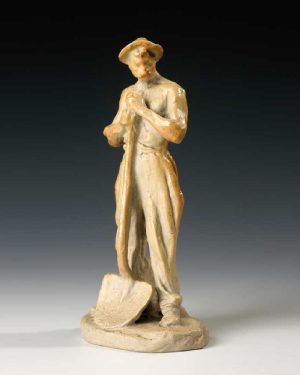
“TERRASSIER A LA PELLE”, 1907
Beige patinated biscuit
Signed and bears the triangular stamp dated 1907
Height: 18.2 cm.
Bibliography
Art et Décoration, September 1903, p. 274: Model illustrated in terracotta Le Biscuit de Sèvres – Recueil des Modèles Modernes de la Manufacture de Sèvres, published by Emile Bourgeois et Geo. Lechevallier-Chevignard, tom II, edited by Pierre Lafitte & Cie, ill. pl. 11,
référence n. 1355 Les œuvres de la Manufacture nationale de Sèvres – Tome II, La Sculpture moderne, ill. pl. 56, n. 1532
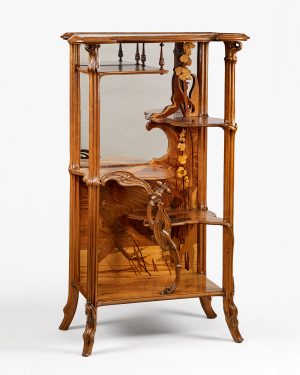
RARE AND IMPORTANT CABINET, CIRCA 1900
Exotic marquetry inlaid wood, decorated with dragonflies and flowers, the front adorned with a dragonfly in relief
Signed
137 cm. high; 83 cm. wide; 44 cm. deep
Bibliography
Alastar Duncan, Georges de Bartha, Gallé Furniture, Antique Collectors’ club, 2012, ill. p. 292
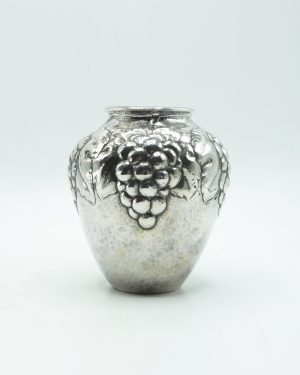
BALUSTER VASE, CIRCA 1920
Hammered silver, decoration of bunch of grape and vine leaves in semi-relief
Signed jean serriere, with foundry mark A HEBRARD and Paris
Height: 14 cm.
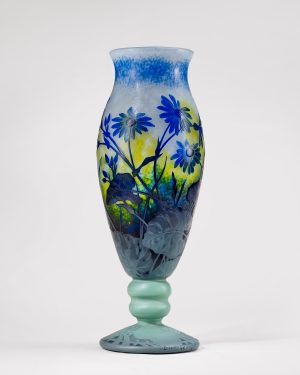
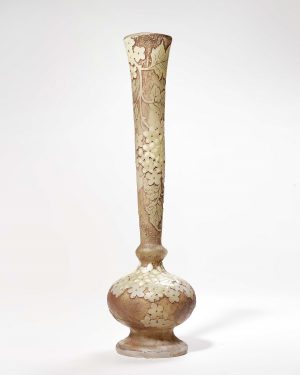
VASE “CINERAIRES”, CIRCA 1910
Clear glass with white, yellow and blue inclusions
The flowers and leaves are acid-etched and wheel carved
Signed
40.5 cm. high
Bibliography
Clotilde Bacri, Daum, Michel Aveline éditeur, 1992, ill. p. 68
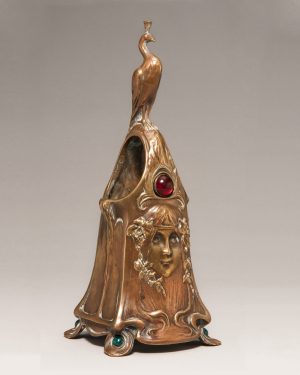
“WOMAN AND PEACOCK” FOOTED VASE, CIRCA 1900
Patinated gilt bronze, with the central motif decorated with a red cabochon, and each of the four feet set with a green cabochon
Signed Flamand
Height: 29 cm.
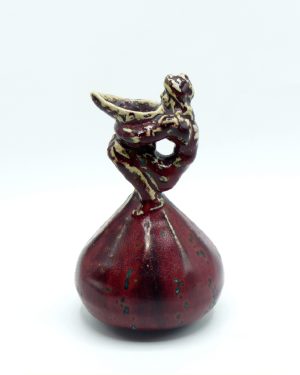
SMALL JUG FEATURING A SEATED FEMALE FIGURE, CIRCA 1892-1893
Stoneware with sang-de-boeuf glaze
Impressed signature “à la grenade éclatée”
Height: 17 cm.
Exhibition Adrien Dalpayrat 1844-1910 / Céramique française de l’Art Nouveau, Arnoldsche Art Publishers, 1998, ill. p. 145, n. 87
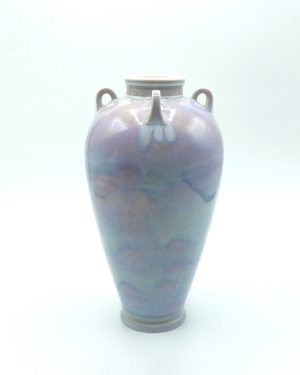
“VASE DE BOURGES A ANSES”, DESIGNED 1896
Form designer: Gustave-Joseph Chéret
Hard-pasted new porcelain, polychrome decoration featuring cloud motifs
Height: 25 cm.
“VASE DE BOURGES A ANSES”, DESIGNED 1893
Pâte Nouvelle (PN) 1900
Bearing the triangular manufacturer’s stamp for 1900 and decoration mark for 1903. Signed L. MIMARD
25 cm. high
Another example is in the Musée de Mâcon
Bibliography
The shape illustrated in (with a different decoration): L’Art Décoratif, October 1900, p. 2 (Exposition Universelle of 1900)
E. Baumgart, La Manufacture Nationale de Sèvres à l’Exposition Universelle de 1900, Paris, Librairie des Beaux-Arts, board 19 (N. 68 in the exhibition catalog)
Jean Paul Midant, Sèvres – La Manufacture au XXème siècle, Paris, Michel Aveline Editeurs,
1992, p. 24
Victor Arwas, Art Nouveau: French Aesthetic, p. 528
Provenance
Joseph Cheret, “directeur des travaux d’art supplémant” from 1886-87 designed only a few forms for Sèvres (one large vase destined for the Paris Opéra foyer). His concentration on a restricted number of models rewarded him with the “Prix de Sèvres” in 1897 for his form and decorative compostion depicting “le Passage de Vénus sur le Soleil”, project for the spacious vestibule of La Bibliothèque Nationale
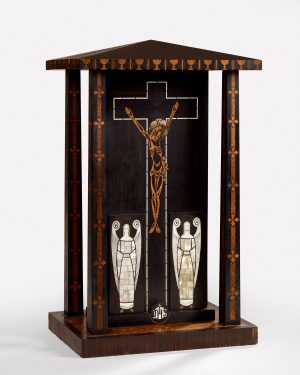
EXCEPTIONAL AND RARE RELIGIOUS ALTARPIECE, CIRCA 1902-1910
Koloman Moser (attributed to).
Featuring a temple with the Christ on the cross and two angels in marquetry of macassar ebony,
incrustation of mother-of-pearl, copper and ivory
The lower part is represented by a pattern design of cubes in marquetry
Inscribed IHS (iota-eta-sigma) or (Iesus Hominum Salvator) 55 cm. high
36 cm. wide
25.5 cm. deep
Probably executed by Koloman Moser for one of the many churches designed and built by himself
between 1902 and 1910. We can unmistakably combine the design and technique of marquetry
which combines the inlaying of ivory, copper, mother-of-pearl and exotic wood with the secretary
made in 1902 by Koloman Moser at Charlottenlund Castle near Stockholm
The stylization of the letters IHS corresponds to the work and research on the lettering and
words that occupied Koloman Moser throughout his career
Koloman Moser (attribué à). Exceptionnel et rare retable religieux figurant un temple avec le Christ en croix et deux anges en marqueterie de placage d’ébène de Macassar, orme et incrustations de nacre, de cuivre et d’ivoire
Le sol est représenté par une marqueterie de jeux de cubes sans fond Inscription IHS (iota-eta-sigma) ou (Iesus Hominum Salvator) Hauteur : 55 cm Largeur : 36 cm Profondeur : 25,5 cm
Probablement réalisé par Koloman Moser pour l’une des très nombreuses églises dessinées et construites par lui-même entre 1902 et 1910 Nous pouvons indiscutablement rapprocher le dessin et la technique de la marqueterie qui combine l’incrustation d’ivoire, cuivre, nacre et bois exotiques avec le secrétaire réalisé en 1902 par Koloman Moser au château de Charlottenlund près de Stockholm La stylisation des lettres “IHS” correspond aux travaux et recherches féconds sur le lettrage et les mots qui ont occupé Koloman Moser tout au long de sa carrière
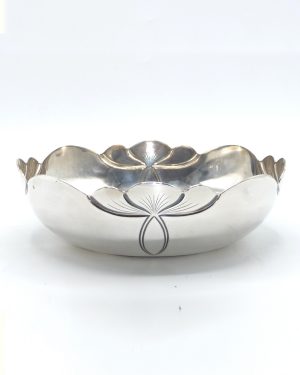
SUGAR BOWL, CIRCA 1900
Silver with cornflower decoration
Carved and green patinated ivory seed. The interior in vermeil
With French Minerva mark, silversmith mark and signed CARDEILHAC / PARIS and U
Height: 13 cm.
Width: 19.7 cm.
“ANCOLIE BLEUE” VEGETABLE DISHES
Exceptional pair of silver covered bowls. With their trays
The cover decorated with an ivory carved seed
With French Minerva mark by CARDEILHAC PARIS and after the drawing by Lucien BONVALLET, circa 1899
Vegetable dishes: 31 cm. long (with the handles)
Diameter of the trays: 34 cm.
Exhibition
Exposition Universelle, Paris, 1900
“Le surtout de table exposé par M. Cardeilhac a retenu tous les examens (reproduit dans l’Art décoratif, août 1900). Et de l’avis unanime, c’était le groupement le mieux entendu de l’orfèvrerie exposée. La forme basse et bien d’aplomb du surtout et de la jardinière, compensée par le bouquet plus trapu des flambeaux et l’interposition des coupes à fruits laisse le mouvement libre pour toutes les pièces du service, comme il permet à chaque invité de voir l’ensemble harmonieux des cristaux, des fleurs, du linge apaisé, et de jouir en un mot du luxe du décor, sans être tenu à des souvenirs archaïques. A une époque où l’orfèvrerie alternait entre les curiosités de la petite sculpture appliquée et les reconstitutions des anciens styles, l’atelier Cardeilhac se maintenait à une réputation très sérieuse par le soin qu’il apportait à toutes les pièces de table. Sa coutellerie est connue dans l’Europe entière et les spécimens en sont aisément reconnaissables. Ce même soin, il l’a apporté à toutes les œuvres de grosserie, et les cafetières comme les légumiers, les chocolatières, les soupières, la platerie sont vraiment des œuvres de la recherche la plus moderne et la plus séante qui soit. Le mouvement floral a fourni les décors admirablement appropriés à chacune des formes, sans en compromettre ni l’assise ni la ligne. Les photographies des différents objets que nous reproduisons indiquent la supérieure entente de ces orfèvreries, dont les galbes, les contours et les très beaux plans décoratifs ont été trouvés et dessinés par M. Bonvallet, un véritable artiste dont les cartons seront à rechercher”. Léon Maillard, Orfèvreries, Orfèvres, l’Art Décoratif, février 1901, page 206
Bibliography L’Orfèvrerie à l’Exposition, Art et Décoration, December 1900, ill. page 163
TINY BOWL DECORATED WITH ALGAE AND SHELLS, MODEL H, FIRST VERSION IN 1906
Pâte d’émail
Signed with the artist’s seal and dated in ink 1906
4 x 8.4 cm.
Exhibition
Véronique Ayrolles, François Décorchemont, Maître de la pâte de verre, Norma éditions, Paris, 2006, ill. p. 221, model H
Musée du Verre François Décorchemont, Conches-en-Ouches, François Décorchemont – L’alchimie de la matière, de la couleur et de la lumière, 24 May 2025 – 30 November 2025
Provenance
Acquired directly from the Décorchemont workshop by the last owner