MILK JUG, CIRCA 1900
White porcelain, with an embossed leaf pattern in blue and pink around the neck. Silver lid featuring the same design
Signed on the base
Porcelain made by Louis Lourioux, Foëcy
With silvesmith mark and E. Lefebvre on the lid
Exhibition
Salon des Artistes Français, 1902
Art Nouveau Belgium/France
Rice Museum, Houston – March 26, 1976 to June 27, 1976
The Art Institute of Chicago – August 28, 1976 to October 31, 1976.
Catalogue n°300, illustrated page 203.
Bibliography
Art et Décoration, July 1902, page 24 L’Art décoratif aux expositions des Beaux-Arts, Armand Guérinet éditeur,
1ère série, 1902, pl. 72 and 73 Orfèvrerie Bijouterie Or et Argent, Catalogue de la maison Lelebvre, ill. 270 : Broc à lait n. 2415
Horst Makus, Keramik aus Historismus und Jugendstil, Kassel 1981, n. 67
Renate Ulmer, Art Nouveau, 1999, Arnoldsche, p. 166, n. 156
PRECIOUS BOX, CIRCA 1900
Chased silver with a design in light relief of foliage and fruits
With french Minerva mark and manufacturer’s mark
In is fitted box of the retailer Alfred Hamel
4.5 cm. high
8 cm. diameter
“ACCOUPLEMENT PREHISTORIQUE, LA CHASSE A LA FEMELLE”, 1887 Color engraving and aquatint engraved by Albert Bertrand, 1906. (Exsteens 943).
31.6 × 24 cm
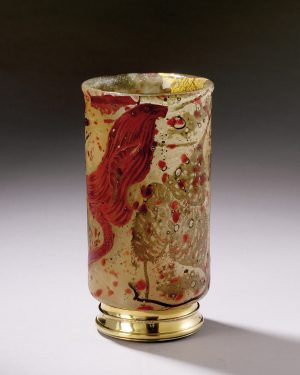
VASE, CIRCA 1900
Engraved marquetry with a design of ray and aquatic flora
Powder inclusions and inclusion of shattered gold foils, hammered with small facets
Silver gilt mount with French Minerva mark
Vertically engraved signature
17 cm. high
No similar example known to exist
Bibliography
For the same shape of the mounted vase: Tsuneo Yoshimizu, The Glass Arts of Emile Gallé, Gakken 1985, n.144; without the mount n. 143 and 184
Georges de Bartha, Glass by Gallé, Thames & Hudson Ltd, 1984, p. 59, n. 61 (EU 1900)
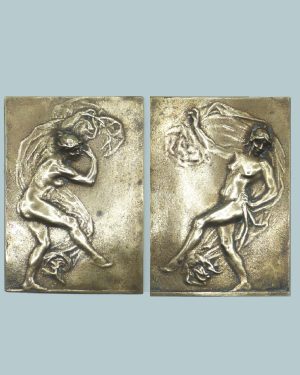
“DANSEUSE AU VOILE” PROFIL DROIT, 1901 – “DANSEUSE AU VOILE” PROFIL GAUCHE, 1901
Set of two bronze plaques decorated with a bas-relief design
13.3 × 9.3 cm.
These plaques were used as decorative mounts for furniture. They can be found on a masterpiece by Charpentier, the cabinet designed to store string quartet instruments, now in the Decorative Arts Museum (inv. no. 13064-A). Two additional plaques are held in the museum’s collections.
Exhibition
Esposizione internationale d’arte, Venise 1901
SNBA 1902, n. 44
Vienne 1903 Exposition d’art français, Strasbourg, palais Rohan, 1907
SNBA 1909 The Beaux-Arts Medal in America, New York, the American Numismatic Society, 1987-88 Les XX. La Libre Esthétique. Cent ans après, Bruxelles, musées royaux des Beaux-Arts de Belgique, 1993-1994
Alexandre Charpentier, Naturalisme et Art Nouveau, musée d’Orsay, 2008, n. 125 and 126 in the exhibition catalogue
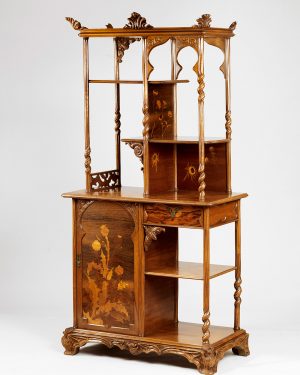
VITRINE, CIRCA 1900
Decorated with marquetry panels and sculptures
of snails, bats, peacock moth and acanthus leaves,
the base entirely sculpted with bats
Signed
191 x 93 x 50 cm.
Another example
The Yamazaki Mazak Museum of Art, Japon, inv. n° ANF-360901
Bibliography
The Yamazaki Mazak Museum of Art, Glass, Ceramic and Furniture, Japon, 2010, ill. p. 114 & 115
Georges de Bartha & al, Gallé furniture, Antique collectors club, 2012, ill. p. 299
CUP, CIRCA 1904
Translucent polychrome enamel on soft white porcelain highlighted with gold.
Signed and dated C. Naudot 1904 and C.N. in gold
Height: 8 cm.
Bibliography
The porcelains by Naudot are illustrated in:
– Art et Décoration, 1901, volum II, page 52
– Der Moderne Stil, Julius Hoffmann jr., A. Guérinet, Paris, Librairie d’Art Décoratif, n.d.,
volum 4, pl. 44
Paul Arthur, French Art Nouveau Ceramics, An Illustrated Dictionary, Norma éditions, 2015, ill. p. 289
FOOTED CUP, 1897-1910
Translucent polychrome enamel on soft white porcelain highlighted with gold
Signed C. Naudot and C.N. in gold.
Height: 4.5 cm.
Bibliography
“M. Naudot est le seul fabricant de porcelaine de pâte tendre, dite porcelaine française.
Il expose nombre de pièces remarquables par la qualité de la matière et l’éclat des émaux
qui les recouvrent. De plus, il a découpé dans la pâte crue des fleurs d’une finesse extrême,
qui, remplies ensuite d’émail, forment sur la pièce comme une fine dentelle lumineuse”.
Alexandre Sandier, La Céramique à l’Exposition Universelle de 1900, Art et Décoration, December 1900, p. 194
Camille Naudot is credited with having mastered the technique of filling the blanks
of his openwork soft paste porcelain with colored translucent enamels without having
to trap them with metal or gold thin wire
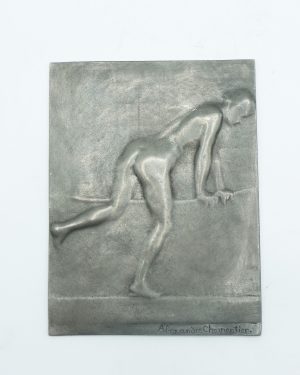
“FEMME ENTRANT DANS SA BAIGNOIRE” or “FEMME MONTANT DANS SA BAIGNOIRE” or “Le Bain”, AFTER 1891
Pewter
Signed Alexandre Charpentier
Height: 17 cm.
Width: 13 cm.
Similar model, unsigned, 17.1 x 13.1 cm., Paris, Musée d’Orsay, inv. n. MEDOR 246
Exhibition
Paris, musée d’Orsay, 22 January – 13 April 2008, ill. p. 163, n. 162
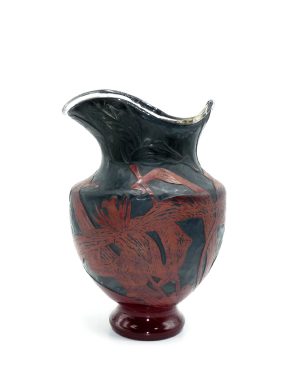
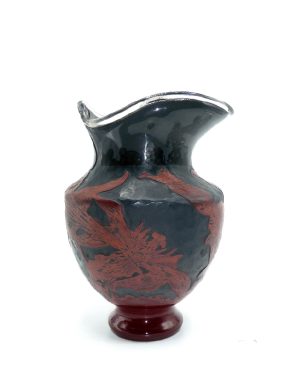
AIGUIERE AUX IRIS, 1893
Multilayered glass, partly hammered with small irregular facets and wheel-carved decor of iris flowers
Height: 22 cm.
Most likely blown and engraved in Meisenthal then wheel-carved in Nancy
Designed to be mounted in silver, an example was acquired directly from Emile Gallé in 1893 by the Union Centrale des Arts Décoratifs, the current Musée des Arts décoratifs, inventory number 7775. The mount is by Joseph Joindy, chased by Francis Peureux who was the main silver chaser at the Maison Boucheron. Our example is the unmounted one that remained in Emile Gallé’s family and no other example known to exist.
In his book L’Oeuvre de verre d’Emile Gallé, copyright 1998 Editions Messene, Paris,
François Le Tacon illustrates a ewer in red and black multilayred glass, that he dates 1893 and which is located in the castle museum of Boulogne-sur-Mer, inventory n. 750, height: 25 cm.; We read: “A l’opposé, une cruche de 1893 (fig.62), sans caractère symbolique, est un objet intrinsèquement décoratif. Soufflée et gravée à Meisenthal à l’acide, puis reprise à la roue à Nancy, elle était destinée à être montée à Paris sur argent doré, comme l’exemplaire du musée des Arts décoratifs. Elle est en cristal triple couche : une interne translucide, une intermédiaire noire foncée et une externe rouge. L’opposition violente entre le noir et le rouge donne à cette pièce un aspect particulier, encore souligné par l’agressivité de la gravure qui s’apparente beaucoup à une taille. La monture en argent ciselé et doré, de style rocaille, avec deux serpents s’enroulant autour de l’anse, plutôt de style Art nouveau, accentue encore les oppositions. La pièce parisienne, à décor d’iris, a été achetée directement à Gallé par le musée; celle de Boulogne, à décor de lys, appartenait à Charles Lebeau”.
“FUSCHIA” COUPE, CIRCA 1908
Pâte d’émail mauve, green and orange brown on a caramel background. Design in shallow relief.
Signed with the circular seal and numbered BK 2. Has its original box.
Height: 5.7 cm.
Diameter: 11.7 cm.
Bibliography
Véronique Ayrolles, François Décorchemont Maître de la pâte de verre, Editions Norma, Paris 2006, ill. p. 40, p. 227
Exhibition
Musée du Verre François Décorchemont, Conches-en-Ouches, François Décorchemont – L’alchimie de la matière, de la couleur et de la lumière, 24 May 2025 – 30 November 2025
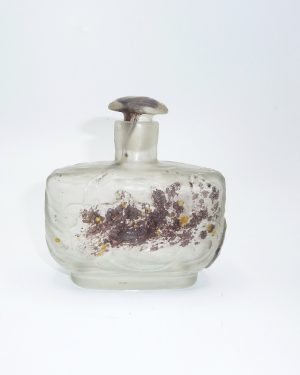
BOTTLE AND STOPPER
Bottle and stopper, of flattened shape, in thick frosted glass with powder and gold foil inclusions,
overlaid and entirely chased with a bat on each side on a background featuring a moon crescent and waves.
Original stopper with hammered top and foil inclusions.
Incised signature on the side.
10.5 x 11 x 4.5 cm.
Bibliography Le Modern Style, page 129
Provenance
Formerly in the collection of Maria de Beyrie, Paris
Private collection, Paris
Acquired from the above
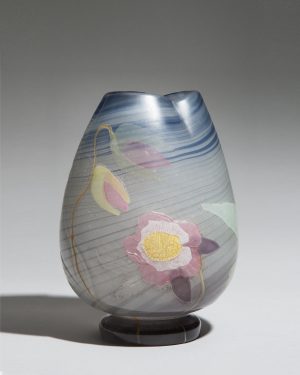
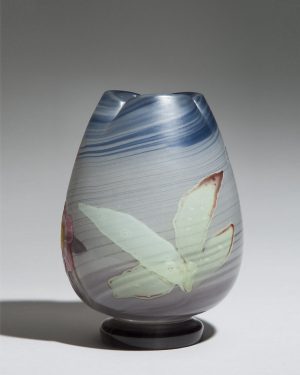
VASE, CIRCA 1900
Footed egg shaped glass marquetry vase with a pinched neck and a design of finely carved water lilies
Similar example at the Kitazawa Art Museum, Suwa, Japon
Height: 19.5 cm.
Exhibition Emile Gallé – Nature and Symbol / Le Langage des Fleurs et des Choses Muettes,
16 January – 10 April 2016, Tokyo Metropolitan Teien Art Museum; 24 April – 5 June 2016, Utsunom
Bibliography
Alastair Duncan, The Paris Salons Volume IV: Ceramics & Glass, ill. on the cover page and p. 40.
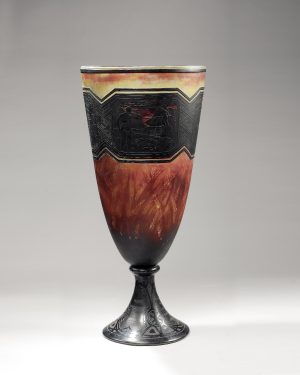
“HOMMAGE A CAMILLE CAVALLIER” LAMP, 1924
Blown and engraved glass
Inscribed: Charlon/Pont à Mousson/Camille Cavallier/Hommage/des Conseillers/du Commerce Extérieur/de la Région de l’Est/1924″ et “Métallurgie/Pont à Mousson/1856/Foug/1905 Au Boue/1905/S’Estienne du Rouvray/1915
Height: 74 cm.
“Ce magnifique vase est la réplique de celui qui a été offert officiellement à Camille Cavallier, président-fondateur des Fonderies de Pont-à-Mousson, en 1924. Sur un fond symbolique de blés mûrs au temps de la moisson, quatre médaillons reproduisent dans une dominante rougeoyante qui leur convient, des scènes d’atelier, depuis la mine jusqu’à la forge. Tous ces motifs sculptés finement dans le verre, sont les témoins de la qualité exceptionnelle des graveurs sur verre de cette époque. Leur travail n’était pas exempt d’aléas, et si ce vase n’est qu’une réplique de l’original, quoique terminé, c’est qu’il est légèrement fêlé. Au cours des derniers coups de roue, une crique s’est déclarée inopinèment, rendant nécessaire la reprise à zéro du travail sur une autre pièce en attente, qui ne dut qu’à un tour de force d’être prête à temps. Le principal auteur du travail était le célèbre H. Racadot”. (Notice of Noël Daum in the catalogue of the exhibition at the Musée des Beaux-Arts de Nancy)
Exhibition DAUM Cent ans de verrerie d’art “trois styles”, 3ème exposition, March 1979 – March 1980, musée des Beaux-Arts de Nancy, n. 16 in the exhibition catalogue
Bibliography
Noël Daum, Daum Maîtres Verriers, Edita Denoël, 1980, ill. p. 108
Clothilde Bacri, Daum, Paris, 1992, ill. p. 152
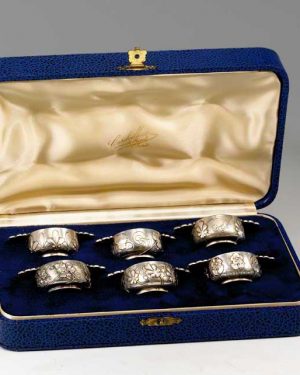
SIX SALT CELLARS, CIRCA 1900
Silver, each with a different design of leaves, including mistletoe, clover, columbine and holly
Signed
Modern fitted box
With silversmith marks
Height: 2.1 cm.
Width: 6.8 cm.