Showing 409–432 of 867 results

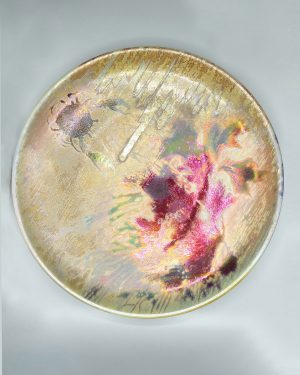
BAPST et FALIZE, Silversmith – LUCIEN HIRTZ, Enameler – “BACCHUS”, 1885-1889

“BACCHUS”, 1885-1889
Plate, enamel on copper
Signed on the reserve in gold: Bapst et Falize Dixit and L. Hirtz.

18 cm. diameter

Lucien Hirtz started to work as a “artiste décorateur” for Bapst et Falize in 1885 then joined the firm of Boucheron in 1893 where he remained until 1925.
The Stieglitz Museum in St. Petersburg has two other plates by Hirtz for Bapst et Falize.
His works are in several museums including the musée d'Orsay, the musée du Petit Palais, the musée des Beaux-Arts de Limoges and major private collections.

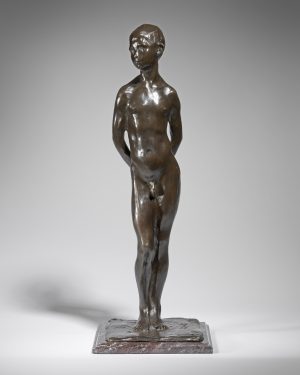
VILLE VALLGREN – SCULPTURE, 1891

SCULPTURE, 1891
Bronze sculpture with nuanced brown patina
Signed Vallgren / Paris1891

22 cm. high

An identical model is to be found at the Danish Museum of Decorative Arts, Copenhagen

Bibliography
Art Nouveau 1890-1914, V & A Publications, ill. p. 66

VILLE VALLGREN – FUNERAL URN

FUNERAL URN
Bronze
Signed
28 cm. high

Exhibition
Société Nationale des Beaux-Arts, Paris, 1901

Bibliography
“Dans cette série des œuvres en métal, nous n'aurions garde d'oublier les petits bronzes de M. Vallgren. Quelques-uns aussi sont destinés à des adaptations de l'électricité ; d'autres sont des coupes, telles que cette coupe soutenue par des femmes ; d'autres de simples figurines presque toujours très spirituelles ; d'autres des vases tels qu'une urne funéraire accompagnée de deux figures d'anges dont les profils se marient étonnamment avec la forme générale de l'objet”. Emile Molinier, Les objets d'art aux Salons, Art et Décoration, July 1901, pp. 29
“…..Bien moins sûr me paraît l'art de Vallgren, qui fut autrefois plus naïf en ses statuettes de Bretonnes, qui se démène aujourd'hui, s'amenuise et se dessèche, et plie le corps humain à des contorsions improbables, mais qui rencontre aussi une bien jolie inspiration en cette urne funéraire, d'une forme fruste et significative, et dont les anses sont formées par deux anges aux longues ailes repliées, telles deux hirondelles en deuil, posées sur un étroit rebord”. Maurice Hamel : La petite sculpture aux Salons de 1901, Revue des Arts décoratifs, 1901, pp. 262 and 263
” Vallgren est resté lui-même, c'est le meilleur compliment à lui faire ; il faut noter dans ses envois une urne funéraire en bronze d'un beau style que l'artiste a exécutée pour lui-même, elle est destinée à contenir ses cendres “. Eugène Belville, L'Art Décoratif, 1905, vol. I, p. 246.

LUCIEN BONVALLET – ANTOINE-ERNEST CARDEILHAC – “CHARDONS” SUGAR BOWL AND SPOON, CIRCA 1900

“CHARDONS” SUGAR BOWL AND SPOON, CIRCA 1900
Chased and engraved silver, the bowl, lid and spoon with a hand tooled,
incised and repoussé design of nine blooming thistles, their heart,
cover knob and handle with carved and stained ivory motifs.
The sugar bowl stamped underneath CARDEILHAC PARIS, with letter K and Maker’s hallmark.
Height: 19 cm.

Exhibition
Exposition Universelle, Paris 1900
Françoise Cachin, [under the direction of] ; Marc Bascou, De Manet à Matisse : sept ans d’enrichissement au Musée d’Orsay, (Paris, musée d’Orsay, November 12 1990-March 10, 1991), Paris, Réunion des musées nationaux, 1990, p. 188

Bibliography
Bouilhet Henri, L’Orfèvrerie française aux XVIIIe et XIXe siècles : 1700-1900. 3, L’Orfèvrerie française au XIXe siècle : deuxième période, 1860-1900, Paris, 1912, p. 367
La Revue du Louvre et des musées de France, Paris, 1990, n. 2, 155
Gabriele Fahr-Becker, Il Modernismo, h. f. ullmann, 2004, ill. p. 95

Another example (without spoon) of this sugar bowl is part of the Collections of the Musée d’Orsay,
Paris, inv. OAO 1199, since 1989

SOLD

JEAN DAMPT – “Tête de bébé à la pomme”, 1895

“Tête de bébé à la pomme”, 1895
Carved marble
Signed and dated 1895
26.5 cm. high

Exhibition
Société Nationale des Beaux-Arts, 1895, n. 26 in the exhibition catalogue
Société Nationale des Beaux-Arts, 1908

Bibliography
Roger Marx, Les Salons de 1895, Gazette des Beaux-Arts, II, ill. p. 113
“M. Dampt, artiste consciencieux et délicat, qui a le mérite, non seulement de modeler
la cire ou la terre, mais aussi de façonner toute matière de sa propre main, me touche
davantage, en somme, dans ses portraits d’enfants, savants et naïfs tout ensemble,
dont il nous montre trois spécimens excellents en argent, en bronze et en marbre”.
L. de Fourcaud, Les Arts décoratifs aux Salons, Revue des Arts Décoratifs, 15ème année,
1894-1895, p. 392
“M. Dampt, artiste précis et ciseleur minutieux, est un des maîtres de la petite sculpture.
Le bébé rieur qu’il nous présente cette année est presque de grandeur nature, mais quel
délicieux morceau de sculpture intime et familière ! C’est la vie même, avec toute sa
fraîcheur naïve, qui éclate dans ces yeux malins, ces joues fermes, cette bouche naïve
vers laquelle se dirige une menotte potelée, et quelle admirable souplesse dans l’exécution
de ce marbre gris rose amoureusement caressé !” Paul Vitry, La sculpture aux Salons, Art et Décoration, June 1903, p. 199

SOLD TO THE MUSEE DES BEAUX-ARTS, DIJON, FRANCE

EMILE GALLE – “LA BERCE DES PRES” DISPLAY CABINET, CIRCA 1900

“LA BERCE DES PRES” DISPLAY CABINET, CIRCA 1900
Decorated with sculpted umbellifers ; the wall studs of the piece of furniture are in beech ; the stems of the umbels are also in beech, as well as the stems starting from the posterior legs meeting in the middle behind the furniture item ; the lateral shelves in the shape of umbels are in walnut, as well as the sculpted umbels above the piece of furniture ; the top of the item is in elm burl veneer ; on the door, the waterway decor is in Japanese “ toné ”, the decor above this aquatic decoration is in ash.
The interior of the piece of furniture is in flame maple ; two shelves are in maple, they correspond with a superior level of positioning in the furniture item, and a shelf is in pine and corresponds to a positioning in the lower part of the piece of furniture.
158 cm. high; 95 cm. wide; 40 cm. deep

Bibliography
Georges de Bartha, Gallé furniture, 2012, The Antique Collectors’ Club, ill. p. 308, pl. 43 together with Gallé’s sketches

Provenance
To the best of our knowledge, only the Museum of Decorative Arts in Lyon owns an identical example which used to belong to Albert Daigueperce ; Albert Daigueperce (catalogue of the Museum of Nancy, Art Nouveau et industrie d’art, page 118)

GEORGES JEAN – SMALL CUP, CIRCA 1900

SMALL CUP, CIRCA 1900
Copper with a polychrome enameled design of violets and leaves
Signed in enamel under the base
4.8 cm. height
8.9 cm. diameter

The Kunstgewerbe Museum de Berlin keeps in its collection an enameled cup decorated with autumn
leaves and berries, signed and located Les-Essarts-Le-Roy. See: Wolfgang Scheffler Werke um 1900,
Kunstgewerbe Museum Berlin, 1966, page 31

PAUL GRANDHOMME – “L’ABREUVOIR”, 1893

“L'ABREUVOIR”, 1893
Enamel on copper
Signed and dated

Plaque: 11.6 x 9 cm.
The frame: 18.3 x 21 cm.

After a painting “peasant watering her cow” by Jean-François Millet which is at the Boston Museum of
Fine Arts (Accession number: 17.1509)

RUPERT CARABIN – CANE, CIRCA 1900

CANE, CIRCA 1900
Bronze
Signed
A similar example in silver is in the collection of the Petit Palais in Paris, France

Exhibition
Exposition R. Carabin, Galerie du Luxembourg, 1974, n. 151 in the exhibition catalogue

Bibliography
C. Dike, La Canne Objet d’Art, p. 327

Provenance
Formerly in the collection of the sculptor Etienne Martin

FRENCH – LORGNETTE, CIRCA 1900

LORGNETTE, CIRCA 1900
Horn, with an applied decoration of silver and enamel butterflies, cut-glass set
with silver stones simulating stars, two opals set with silver holding the mount in vermeil
Bearing the silversmith and maker’s marks

24 cm. long

Provenance
John Jesse, London, acquired in 1996

JANVIER QUERCIA – POCKET WATCH BOX, CIRCA 1905

POCKET WATCH BOX, CIRCA 1905
Finely chased and hammered silver with a relief decoration of vine branches
and leaves, decorated with plique à jour enamel, the grapes in amethyst-colored glass
Bearing the silversmith and Minerva marks

7.5 cm. diameter

Silversmith and jeweler, Quercia executes jewels, mainly in silver but also in gold, for many prestigious jewelers including Vever. Among the plaques and medals exhibited at the Société des Artistes Français in 1900, a Madonna and Child
by Ch. Pillet and a medal by Théodore-Rivière are reported as belonging to M. Quercia elder, most probably Janvier Quercia. Hence we assume that he edited works of these two artists.Quercia specialized in the creation of belt buckles, canes and umbrella handles, chains, pendants and brooches, finely
chased and incorporating enamels. He also distinguished himself by designing religious silverware

CHRISTOFLE & CIE – STRAWBERRY SERVING SET, BEFORE 1898

STRAWBERRY SERVING SET, BEFORE 1898
Silver and vermeil Comprising: A shovel, interior in vermeil, reference in the Christofle catalogue of 1898 n. 6850
A sugar spoon, with an openwork design, interior in vermeil, reference in the Christofle catalogue n. 6851
12 strawberry spoons, interior in vermeil, reference in the Christofle catalogue n. 6852

Shovel : 16.5 cm. long
Sugar spoons : 15.5 cm. long
Spoons : 12.6 cm. long

Exhibition
Orfèvrerie Christofle, Tarif Album, 1898, ill. p. 129
David Allan, Le couvert et la coutellerie de table française du XIXᵉ siècle, ill. p. 220

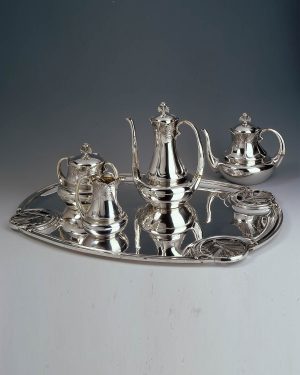
PIERRE-AUGUSTE ARNOUX – CHRISTOFLE & CIE, HENRI GODIN – LEON MALLET, Chaser – VERY RARE COFFEE SERVICE “PINECONES AND NEEDLES, 1896

VERY RARE COFFEE SERVICE “PINECONES AND NEEDLES, 1896
Comprising a chased silver and silver gilt coffee pot, a covered sugar bowl, milk jug and matching tray
Each piece fully signed, bearing Minerva and makers marks and numbered

Coffee pot: 21 cm. high
Sugar bowl: 12 cm. high
Milk jug: 8 cm. high
Tray: 35 cm. diameter

Exhibition
Salon de la Société Nationale des Beaux-Arts, Paris, 1896
Exposition Universelle, Paris, 1900

Bibliography
“A M. Henri Bouilhet et aux ateliers de la maison Christofle nous devons quelques très beaux morceaux d’orfèvrerie où l’ornement végétal est finement adapté à des formes de poteries très simples, commodes et d’un bon profil.
Dans un service à thé la feuille de chêne joue un rôle décoratif plein d’élégance. Une chocolatière s’enrichit pittoresquement de têtes et de feuilles de céleri. Le décor de deux cafetières s’emprunte aux aiguilles et aux pommes du pin et à la feuille
du platane… Le catalogue de l’Exposition nous fait connaitre les collaborateurs de M. Henri Bouilhet et je me fais un plaisir de citer leurs noms : les modèles sculptés sont de M. Léon Mallet et la ciselure est de MM. Arvisenet, Lindermann, Portrait,
Marionnet, Roze et Simon”. L. de Fourcaud, Les Arts décoratifs aux Salons de 1896, Revue des Arts décoratifs, July 1896, p. 229
Art et Décoration, 1900, vol. II, coffee pot illustrated p. 173
Tony Bouilhet, L’Orfèvrerie française au XXème siècle, éditions Émile-Paul frères, Paris, 1941, coffee pot illustrated in one of the plates

LUCIEN BONVALLET – ANTOINE-ERNEST CARDEILHAC – PAIR OF FRUIT BOWLS, CIRCA 1900

PAIR OF FRUIT BOWLS, CIRCA 1900
Wheel cut crystal on silver bases
With silver and makers marks

Bowl: 25 cm. diameter
Weight of silver base: 1060 gr.

Between 1894 and 1899, Lucien Bonvallet designed for Cardeilhac a large array of silverware destined for the Exposition Universelle. Tea and coffee services in two sizes with their matching trays in engraved silver or pyrographed with silver mounts, handles and finials in either ebony or tinted ivory, sculpted ivory and silver candy dishes, vases, soup tureens, vegetable dishes and plates, fruit bowls, scent bottles, eggcups, a large centerpiece that included a jardinière and candlesticks. He drew his inspiration from flowers and plants which were transposed on the various models: thistles, columbines, mistletoe, clovers and chestnut leaves

All of those models were exhibited in January and February 1913 at the pavillon de Marsan, Musée des Arts décoratifson the occasion of a retrospective exhibition of Lucien Bonvallet

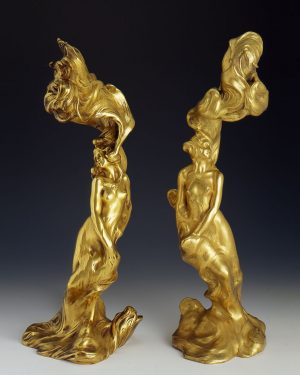
EDWARD COLONNA – ART NOUVEAU BING – TABLE LAMP, CIRCA 1901

TABLE LAMP, CIRCA 1901
Metal, four waterleaf in relief on the base
Signed
48 cm. high

Exhibition
Dr. Martin Eidelberg, E. Colonna, Dayton Art Institute, 1984, fig. 1, p.47, n°99, p. 86 in the exhibition catalogue

Bibliography
” Une lampe de ” L’Art Nouveau Bing “, dont le modèle a été donné par M. Colonna, ainsi qu’une autre, composée par M. Paul Follot pour la Maison Moderne, sont des lampes de table ou de bureau, à foyer caché par un abat-jour. On trouvera dans celle de M. Colonna une très grande grâce. La ligne se poursuit d’un jet depuis le pied jusqu’au sommet, accentuée par des épanouissements de feuilles, et s’arquant pour suspendre l’abat-jour de soie moulé sur des côtes en spirale “. L’Art Décoratif, March 1903, ill. p. 80
Renate Ulmer, Art Nouveau Symbolismus und Jugendstil in Frankreich, Arnoldsche, 1999, ill. p. 133, n°113

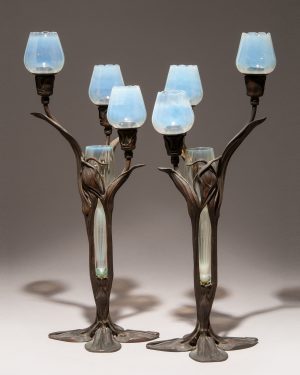
EDWARD COLONNA – ART NOUVEAU BING – TABLE LAMPS, CIRCA 1901

TABLE LAMPS, CIRCA 1901
Metal, four waterleaf in relief on the base.
Signed
48 cm. high

Exhibition
Dr. Martin Eidelberg, E. Colonna, Dayton Art Institute, 1984, fig. 1, p.47, n°99, p. 86 in the exhibition catalogue

Bibliography
” Une lampe de ” L’Art Nouveau Bing “, dont le modèle a été donné par M. Colonna, ainsi qu’une autre, composée par M. Paul Follot pour la Maison Moderne, sont des lampes de table ou de bureau, à foyer caché par un abat-jour. On trouvera dans celle de M. Colonna une très grande grâce. La ligne se poursuit d’un jet depuis le pied jusqu’au sommet, accentuée par des épanouissements de feuilles, et s’arquant pour suspendre l’abat-jour de soie moulé sur des côtes en spirale “. L’Art Décoratif, March 1903, ill. p. 80
Renate Ulmer, Art Nouveau Symbolismus und Jugendstil in Frankreich, Arnoldsche, 1999, ill. p. 133, n°113